What is the Russell Index?
Key Points
The Russell index is currently the most widely covered index in the capital markets.
The Russell index is based on the U.S. market as the original benchmark, focusing mainly on U.S. listed companies.
The Russell index is compiled using a market capitalization weighted average method, which is one of the best tools to measure the stock prices of small businesses.
Concept Explanation
The Russell index mainly refers to the U.S. index series launched by the American company Frank Russell in 1984 to measure the U.S. market and track the performance of large and small U.S. stocks.
As the index compilation gradually expands, the combination of the Russell U.S. index and the Russell style index now covers approximately 10,000 stocks from 63 countries worldwide, encompassing 98% of the investable market.
According to indicators such as country, region, industry, and size, the Russell index has over 300 sub indices, with the most important ones being the Russell 1000 index, Russell 2000 index, Russell 3000 index, among others.
In 2015, London Stock Exchange Group (LSEG) subsidiary FTSE Group and Frank Russell Company jointly launched the FTSE Russell Index trademark, with the Russell Index belonging to the FTSE Russell Index system.
Index Characteristics
Compared with the traditional three major US stock indexes, the Russell Index can better reflect the overall market.
Specifically, the Russell Index has the following three major characteristics:
First, the core of the Russell US Index is of ‘American nationality’. Since the inception of the Russell Index, it has used the US market as the original benchmark, focusing on US domestic listed companies.
Second, the Russell Index does not rely on the subjective judgment of index institutions, but strictly adheres to market capitalization as the basis for decision-making, determining the position of stocks in the index through a weighted average method, making it one of the best tools for measuring small business stock prices.
Third, the Russell Index has derived Russell Value Index, Russell Growth Index, Russell Defensive Index, and so on based on market styles, starting to cover listed companies globally, with significant differences in stock selection styles.
What is the Russell 2000?
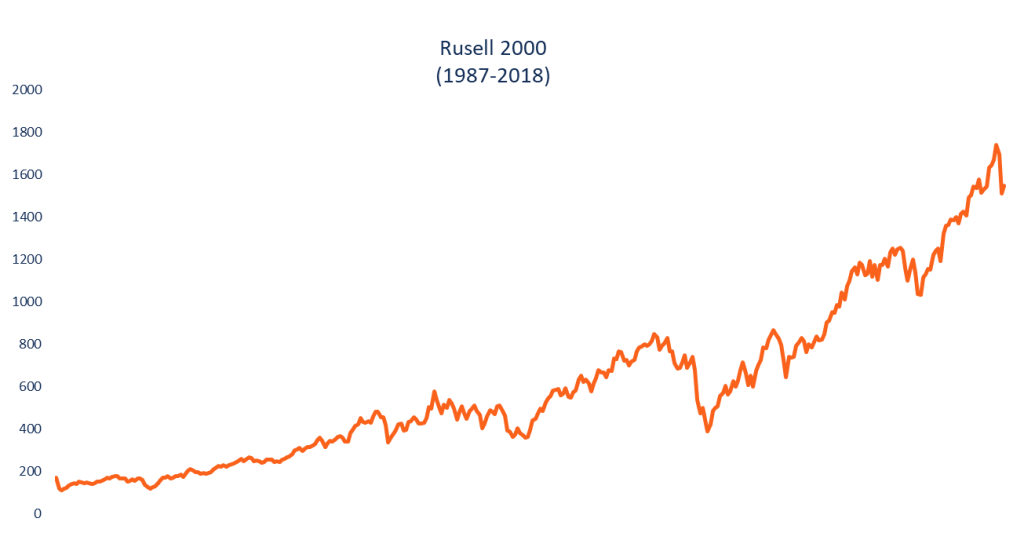
The Russell 2000 is a stock market index that tracks the performance of 2,000 US small-cap stocks from the Russell 3000 index. The Russell 2000 index is widely quoted as a benchmark for mutual funds that consist primarily of small-cap stocks. It is also a benchmark for the performance of small-cap stocks overall. Created in 1984, the index is operated by the London-based FTSE Group.
Components of the Index
Currently, the Russell 2000 index consists of 2,040 companies. Despite the large number of constituents, the index represents only about 8% of the total market capitalization of the Russell 3000 index.
Similar to many other major stock market indices, Russell 2000 is a capitalization-weighted index. As of September 2018, the average market capitalization of the index’s constituents is around $2.4 billion.
Although the index tracks the performance of small-cap stocks, it excludes penny stocks (stocks traded below $1 per share)。 In addition, it excludes non-US stocks, royalty trusts, and limited partnerships. New constituents are added to the index on a quarterly basis. Index components that no longer comply with the listing requirements are removed from the index annually.
The general consensus is that the Russell 2000 provides a better reflection of the US economy because its components are smaller companies with a focus on domestic businesses.
How to Invest in the Russell 2000?
The index can be an attractive investment opportunity for interested investors. Although direct investments in the index are not possible, there are several funds and ETFs that replicate the performance of the index. An investor can simply invest in the funds or ETFs and receive returns similar to the returns of the index. The most popular options include:
iShares Russell 2000 ETF
Vanguard Russell 2000 ETF
Both ETFs manage a large asset base ($25 billion and $1 billion, respectively) to replicate the performance of the index as closely as possible.