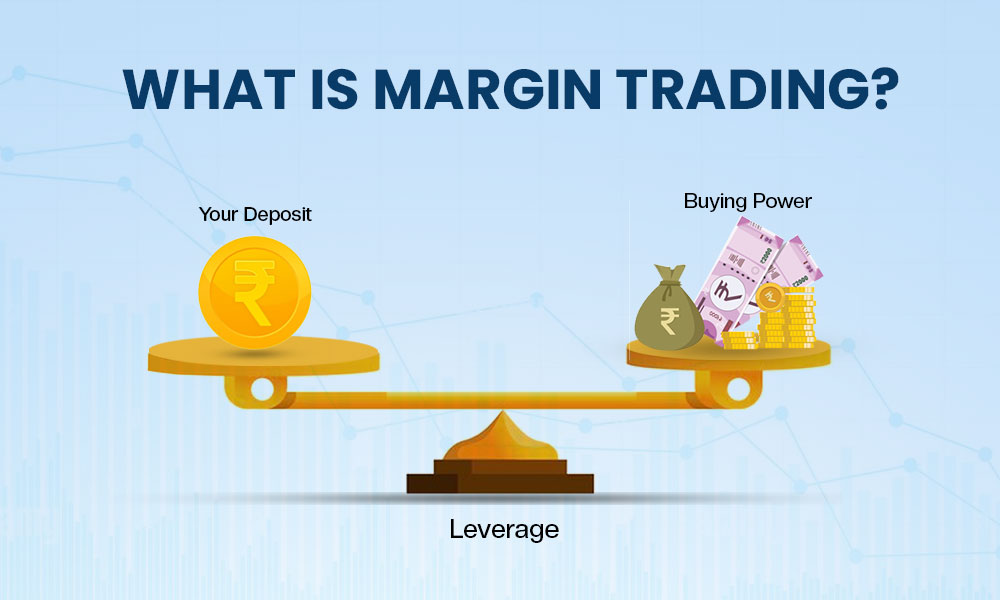
What is margin trading?
Key Points
Margin trading involves using the securities or cash in an account as collateral to borrow funds or securities from a broker for trading.
Margin trading uses leverage, which amplifies both gains and losses on investments.
When engaging in margin trading, investors must deposit an initial margin and meet the maintenance margin requirements.
Detailed Explanation
Margin trading refers to the practice where, in the process of buying or selling securities, the parties involved only need to deposit a certain amount of margin (or securities) with the securities company, which then provides financing or lending of securities. Margin is the amount of money that must be deposited with the broker when borrowing to purchase securities.
In margin trading, investors use the eligible securities or cash in their brokerage accounts as collateral to secure a loan. Interest on the loan will be calculated and charged periodically.
For example, if your broker requires an initial margin of 60% for a particular stock, and you wish to purchase $10,000 worth of that stock, you would need to provide $6,000 as margin, with the remaining $4,000 being borrowed from the broker.
If an investor wishes to trade on margin, they need a margin account rather than a standard cash account. A margin account is a standard brokerage account that allows investors to use the cash or securities in their account as collateral for a loan. Each broker has different requirements for qualifying for margin trading and offers different terms of service. Brokers can set their own margin requirements and interest rates.
In margin trading, because investors use leverage, both losses and gains are magnified.
Advantages and Disadvantages of Margin Trading
Advantages:
1. Increased Purchasing Power
The most obvious benefit of margin trading is that it amplifies the investor’s purchasing power. Margin trading allows borrowing to trade, enabling investors to buy more stocks than they would with a cash account.
2. Higher Potential Returns
Margin trading leverages capital, thereby increasing the potential for profit.
Disadvantages:
1. Higher risk
Borrowing to invest carries risks. Regardless of whether the purchased securities appreciate or depreciate, the investor must repay the borrowed amount.
2. Interest costs
Borrowing is not free. When using margin for investment, the investor must pay interest on the borrowed amount. Before engaging in margin trading, investors should consider the cost—fixed interest expenses. Even if the stocks purchased maintain their value, the cost of borrowing will result in a loss.
3. Margin requirements
When an investor wishes to engage in margin trading, they must deposit an initial margin, typically a certain percentage of the transaction amount. This margin, once deposited, is held in a margin account with the clearinghouse. The initial margin serves as a safeguard to prevent losses to the counterparty in case of any adverse price changes.
After a margin trade, the ratio of the margin amount to the market value of the purchased securities will fluctuate with the market. The investor must ensure that this ratio remains above the minimum level set by the broker.
If an investor fails to meet the maintenance margin requirement, a margin call may be triggered, notifying the investor to deposit additional funds. If the investor does not meet the margin call within the specified period, the securities firm may liquidate the position.
What is OTC trading?
Key takeaways
1、Over-the-counter (OTC) refers to the direct securities trading between buyers and sellers outside of the stock exchange.
2、Over-the-counter trading has its unique characteristics in terms of trading symbols and trading methods.
3、Over-the-counter trading has poor liquidity, limited public information available, and may lead to credit risks.
Understanding Over-the-Counter Trading
Over-the-counter trading is conducted directly between the two parties without the supervision of a stock exchange. In OTC trading, the trading prices are not necessarily publicly disclosed. It contrasts sharply with exchange trading, which has transparent prices and liquidity.
Over-the-counter trading involves a wide variety of securities. Stock exchanges have strict listing requirements for listed securities, only accepting those that meet stringent criteria, resulting in a relatively small number of securities available for exchange trading.
On the other hand, over-the-counter securities are usually unlisted securities that do not need to meet the strict listing conditions set by stock exchanges and regulatory authorities. Therefore, their quantity is quite large. Compared to listed securities, over-the-counter securities offer a richer and more diverse range of options. It’s worth noting that unlisted securities are not necessarily low-quality securities. Some securities are not traded on stock exchanges simply because the issuer has not applied for listing.
In the USA, newly issued stocks by joint-stock companies can be transferred through over-the-counter trading, and some federal government securities, municipal bonds, and corporate bonds are also traded through over-the-counter trading.
Advantages and Disadvantages of Over-the-Counter Trading
Securities listing must comply with the strict listing conditions stipulated by the exchange, and the issuer must fulfill strict disclosure obligations. At the same time, for the issuer, applying for securities listing is a relatively costly financing activity, and the issuer must bear various listing-related expenses. This may not be what smaller companies with relatively small financing needs and companies hoping to keep financial and operational secrets anticipate. Therefore, both over-the-counter trading and the regulated market are indispensable, each with its positive significance. However, over-the-counter trading also has its drawbacks. Generally, trading institutions in the over-the-counter market are just intermediaries, and they do not provide settlement guarantees to investors. Investors need to bear credit risks on their own. Some over-the-counter trading markets lack supervision, which may result in opaque quotations and make it difficult for investors to uphold their rights in case of disputes. Here are some specific advantages and disadvantages.
Advantages
Over-the-counter trading provides securities that cannot be obtained on the exchanges, such as delisted stocks, bonds, and financial derivatives.
Over-the-counter trading offers companies seeking to maintain financial and operational secrecy an opportunity to raise substantial funds.
Larger price spreads and fewer regulations in over-the-counter trading make it possible for speculative investors to potentially achieve higher returns.
Disadvantages
OTC trading is subject to less regulation, meaning counterparties have higher default risks and it is difficult to protect rights.
OTC trading stocks may face the risk of less company information disclosure, leading to misinformation among investors about future prices.
Some securities in the OTC trading market may have difficulty being bought or sold due to lack of liquidity.
USA OTC Markets Group
OTC trading originated in the USA, where the trading market once had two main participants: Pink Sheets and the OTC bulletin board (OTCBB) operated by the Financial Industry Regulatory Authority (FINRA)。 However, FINRA officially ceased the operation of OTCBB on November 8, 2021.
Currently, the main participant in the OTC market is the USA OTC Markets Group, a financial platform providing price and liquidity information for over 10,000 OTC securities. OTC Markets Group mainly offers services in three core areas: trading services, market data, and corporate services. Note that it is not a securities exchange.
OTC securities are listed on three levels of markets: the OTCQX market with the strictest listing requirements; the OTCQB venture market with certain listing requirements; and the Pink Sheets public market allowing financially distressed or bankrupt companies to enter the market. Among these three markets, in terms of the number of companies and trading volume, the Pink Sheets public market is the largest.