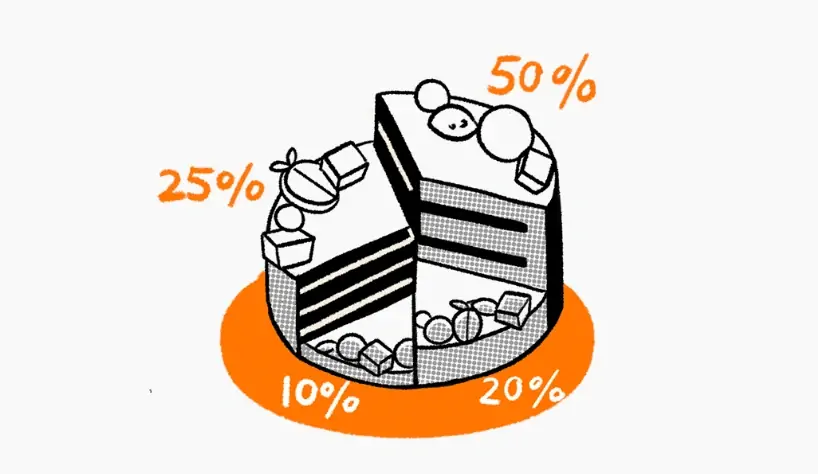
What is an investment portfolio?
Key Points
The essence of a portfolio is not to put all your eggs in one basket, thereby diversifying risk.
Portfolios have three characteristics: diversification, weak correlation, and personalization.
When building a portfolio, factors such as individual’s age, risk preference, etc., can be taken into consideration.
Concept Explanation
A portfolio is a combination of assets in one basket, which can include stocks, bonds, financial derivatives, precious metals, cash, and other types of assets.
As we often hear, ‘Don’t put all your eggs in one basket,’ similarly, do not invest all your money in the same asset.
By putting eggs in different baskets, even if eggs in one basket break, the other eggs remain unharmed. Similarly, the core purpose of building a core portfolio is to diversify risk. A single asset may experience significant fluctuations, but if a portfolio is composed of multiple types of assets, the fluctuations of various assets offset each other, reducing the overall risk of the portfolio.
Three main characteristics
Generally, an investment portfolio has three main characteristics.
First, diversification. Only by purchasing different types of assets, reducing the weight of a single asset, and diversifying investments, can the risk of the investment portfolio be reduced.
Second, low correlation. The assets within the investment portfolio should have poor correlation. For example, for stocks, if you simultaneously buy baijiu industry Moutai and Wuliangye, the correlation between these two stocks is significant, which loses the significance of risk diversification.
Third, customization. The composition of assets in the investment portfolio needs to vary according to the individual. If you have a high risk preference, you can allocate more to stocks and other equity assets. If you have a low risk preference and extremely dislike losses, you can allocate more to bonds and other low-risk assets, or even hold cash.
How to build a portfolio
How to build an investment portfolio? Here is a relatively simple method, using an interesting little formula: 100 – age, the resulting number is the percentage of funds to be invested in stocks or stock funds and other equity assets.
The logic behind this formula is that the younger you are, the stronger your earning ability, the higher your risk tolerance, and the more you can allocate to some high-return high-risk assets. For example, if you are currently 30 years old, you can buy 70% of stocks or stock funds, and allocate the remaining 30% to bonds, mmf, gold, and other relatively low-risk assets.
At the same time, within a certain type of assets, it is also necessary to diversify the allocation. For example, for stocks assets, risk can be diversified by buying different stocks, preferably selecting stocks from different industries and types.
What is return on investment?
Key Points
The investment return rate refers to the ratio between the income from investment and the cost.
The main factors affecting the investment return rate are investment risk and liquidity.
Different investment varieties have different potential investment return rates.
Concept Explanation
The return rate of investment refers to the ratio between the income from investment and the cost, generally expressed as an annual percentage, which is what we call the annualized return rate. Marx once said, in order to gain a 100% profit, capital dares to trample on all human laws. Here the 100% refers to the investment return rate.
The factors influencing the return rate include investment risk and liquidity. Returns and risks go hand in hand, seeking high returns often entails high risks. Investment varieties with lower liquidity often require compensation in terms of the investment return rate. For example, the return rate of fixed-term deposits is often much higher than that of current deposits.
The return rates of common investment varieties
Bank deposits/money market funds: zero or low risk, with investment return typically within 3%.
Stock investment: high risk, high return. Taking the performance of the NASDAQ index as an example, the annualized return over the 10 years from 2011 to 2020 was approximately 17%. However, if one enters at a high point, there is also a possibility of short-term losses.
Fund investment: high risk, high return. Some famous fund managers have achieved long-term annualized returns of over 15%, but there are also funds with negative investment returns.
How to increase investment return?
Firstly, risk management is essential to prevent capital loss. Warren Buffett’s annualized investment return has exceeded 20% over several decades, thanks to his adherence to three key investment principles: first, preserve capital; second, preserve capital; third, always remember the first and second rules.
Simultaneously, enhancing learning is crucial. One can never earn money beyond their cognitive abilities, as investing is the realization of knowledge. By continuous learning and broadening one’s knowledge base, there is a possibility of improving investment return. The series of investment courses in Futu Education is a good learning choice.