One thing that often trips up newer investors when evaluating semiconductor stocks is that many traditional valuation metrics don’t work as expected. One example is the forward price-to-earnings (P/E) ratio, calculated by dividing a company’s share price by its expected earnings over the next 12 months.
Those earnings are based on consensus estimates, meaning the average projections from analysts covering the stock. The ratio reflects what investors are paying today for a company’s expected future profits, and all else equal, lower is often seen as a better value.
However, this framework can break down in cyclical sectors like semiconductors. Take Micron Technology Inc. (ticker: MU), which surged about 513% on a one-year price return basis as of April 13, driven largely by strong demand for memory chips tied to AI.
Despite that run, the stock still shows a forward P/E of 7.3 according to Yahoo Finance, which on the surface may look cheap. But this may be a classic example of the “peak earnings trap,” where companies appear inexpensive because their earnings are temporarily elevated at the top of a cycle.
In cyclical industries, earnings expand when conditions are strong and contract when demand weakens. At the peak, profits are unusually high, which lowers the P/E ratio and can make the stock look like a bargain. But those earnings are not sustainable in perpetuity.
Even if the share price doesn’t fall, declining earnings eventually can make the valuation look much more expensive, and in many cases, the market adjusts by repricing the stock lower as expectations reset. This dynamic makes timing individual semiconductor stock investments especially difficult.
But beyond cyclicality, semiconductor investors also need to navigate supply chain and geopolitical risks. Export controls, trade restrictions and regional conflicts can cause disruptions. Supply-side shocks might include factory shutdowns or shortages of critical inputs, while demand-side shocks can occur if major buyers, such as China or large cloud providers, pull back spending due to policy or management changes.
Despite these risks, the long-term growth story for semiconductors remains intact. The rise of AI is a major driver, with hyperscalers and cloud providers investing heavily in data centers that require advanced chips for computing, storage and networking. Semiconductors are often cited as a bottleneck in this buildout, reinforcing their importance in the global economy.
For investors, one of the simplest ways to access this theme is through a semiconductor exchange-traded fund, or ETF. These funds trade with a bid and ask price, offering liquidity similar to stocks. They hold a basket of semiconductor companies, either selected by a portfolio manager or via a rules-based index.
While investors pay an annual expense ratio, they gain diversification, which can help smooth out volatility and reduce company-specific risk while still capturing the upside from industry leaders.
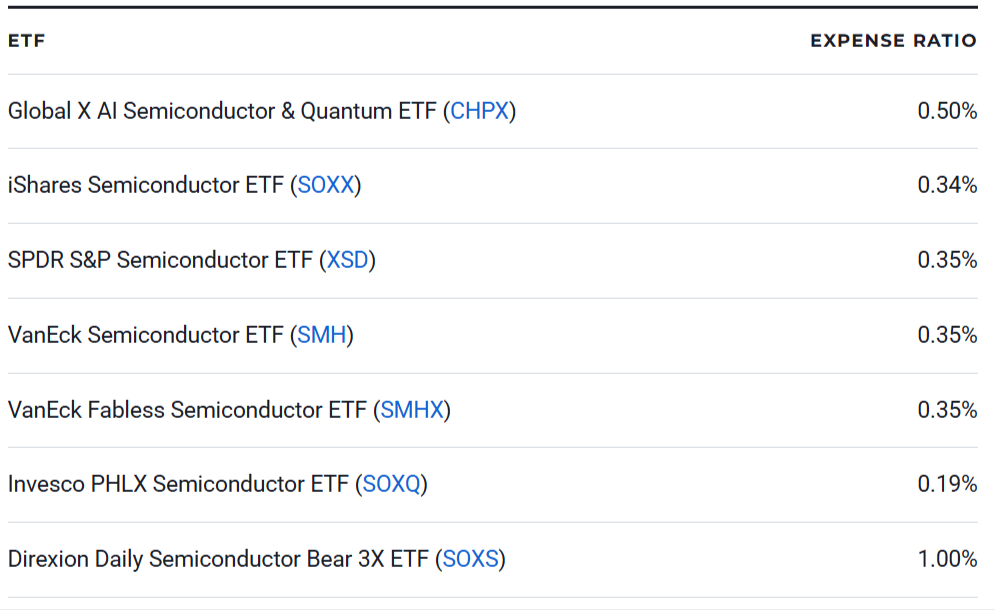
Here are seven of the best semiconductor ETFs to buy today:
ETF
Global X AI Semiconductor & Quantum ETF (CHPX)
iShares Semiconductor ETF (SOXX)
SPDR S&P Semiconductor ETF (XSD)
VanEck Semiconductor ETF (SMH)
VanEck Fabless Semiconductor ETF (SMHX)
Invesco PHLX Semiconductor ETF (SOXQ)
Direxion Daily Semiconductor Bear 3X ETF (SOXS)
Global X AI Semiconductor & Quantum ETF (CHPX)
“The semiconductor shift is most visible on three fronts: the transition from general-purpose processors to AI-optimized chips, the use of high-bandwidth memory to handle AI’s data intensity and the rise of ultra-fast interconnect solutions that bind AI servers together,” says Tejas Dessai, director of thematic research at Global X ETFs. For semiconductors, Global X ETFs offers CHPX at a 0.5% expense ratio.
“CHPX provides exposure to companies across the entire global compute stack, from AI semiconductors to data center equipment, power infrastructure and quantum technologies,” Dessai says. The two largest holdings in CHPX’s portfolio of 36 companies are currently ASML Holding NV (ASML) and Taiwan Semiconductor Manufacturing Co. Ltd. (TSM) at roughly 11.4% and 10.3%, respectively.
iShares Semiconductor ETF (SOXX)
“The potential benefits of investing in semiconductor ETFs include exposure to a high-growth industry with strong fundamentals, diversification across multiple companies in the industry and the potential for long-term capital appreciation,” says Sean August, CEO of the August Wealth Management Group. For example, the 30 companies in SOXX have delivered a 28.1% annualized total return over the past decade.
Unlike CHPX, ASML and TSM are not top holdings in SOXX. Instead, the ETF emphasizes U.S.-domiciled firms like Broadcom Inc. (AVGO), Nvidia Corp. (NVDA), Micron and Advanced Micro Devices Inc. (AMD)。 SOXX is also more affordable than CHPX, with a lower 0.34% expense ratio. For a $10,000 investment, this works out to roughly $34 versus $50 a year in fee drag, all else being equal.
SPDR S&P Semiconductor ETF (XSD)
“When looking for semiconductor ETFs, investors should consider factors such as the expense ratio, the underlying index or benchmark, the fund’s holdings and diversification strategy, and the ETF’s historical performance,” August says. “It is also important to assess the fund’s liquidity to ensure that it is easy to buy and sell.” These factors can make a material difference for a semiconductor ETF’s risk and return.
For example, XSD’s 10-year annualized return has trailed SOXX, at 22.6%. This is because the ETF employs an equal-weighted methodology. Unlike SOXX, XSD is not top-heavy in the largest U.S. semiconductor stocks. When the ETF rebalances periodically, small, medium and large semiconductor stocks all get the same weight. This reduces concentration risk, but can also prevent winners like NVDA from running.
VanEck Semiconductor ETF (SMH)
“Near-term, the backdrop for semiconductors remains supportive as hyperscalers continue to spend heavily on AI infrastructure, and demand stays firm across compute, memory and networking enablers,” explains Nick Frasse, product manager at VanEck. “Long-term, we think the opportunity expands further as AI adoption spreads from data centers into enterprise use cases like edge computing and robotics.”
SMH is VanEck’s flagship semiconductor ETF, with about $50 billion in assets. “The fund holds 25 of the most liquid U.S.-listed semiconductor companies, based on market cap and trading volume,” Frasse explains. The ETF’s portfolio is dominated by NVDA, at 18.4%, due to the stock’s streak of outperformance. SMH has returned 31.3% annualized over the trailing 10-year period.
VanEck Fabless Semiconductor ETF (SMHX)
Semiconductor companies are split between those that design chips and those that manufacture them in fabrication plants, or “fabs.” These facilities are extremely capital intensive, and only a few firms, most notably TSM, dominate this space. SMHX removes that exposure by focusing on fabless companies that outsource production. This business model emphasizes intellectual property and innovation.
“We believe SMHX is well positioned for an environment where design, architecture and intellectual property matter more and more,” Frasse says. “As advanced compute becomes harder to scale efficiently, the ability to deliver better performance per watt and per dollar becomes increasingly valuable, which we see as a key advantage for fabless semiconductor companies moving forward.”
Invesco PHLX Semiconductor ETF (SOXQ)
Semiconductor ETFs can vary widely in terms of expenses. At one end are more specialized thematic funds like CHPX, which focus on niche areas such as quantum and AI and charge higher fees as a result. On the other end are more traditional semiconductor ETFs like XSD, SMH and SMHX, which charge 0.35% annually. Investors looking for semiconductor exposure at a lower cost may find SOXQ appealing.
This ETF tracks the PHLX Semiconductor Sector Index, which includes 30 of the largest U.S.-listed semiconductor companies. The portfolio leans heavily toward industry leaders and has significant overlap with funds like SMH and SOXX. However, SOXQ undercuts on price, charging just a 0.19% expense ratio.
Direxion Daily Semiconductor Bear 3X ETF (SOXS)
“Semiconductors are the engine powering the AI revolution and the modern economy,” says Mo Sparks, chief product officer at Direxion. “Be it through trillion-dollar market caps, earnings surprises and misses, tariffs, or broader geopolitical events, traders have plenty of catalysts to guide their conviction.” For those who believe the current semiconductor cycle has peaked, an inverse ETF like SOXS may be suitable.
SOXS uses swaps to deliver three times the inverse daily return of the NYSE Semiconductor Index, the same benchmark tracked by SOXX. For investors looking to express a bearish short-term view, it can serve as an alternative to buying put options or shorting semiconductor stocks directly. The ETF carries a high 1% expense ratio and is generally best suited for short-term holding periods.