Most investors are familiar with the Nasdaq composite, an index of more than 2,500 U.S. stocks that has a heavy concentration in the technology sector. There are a number of funds out there that can give investors diversified exposure to the Nasdaq composite, but there’s also another index that avoids some of the risks that come with small-cap volatility.
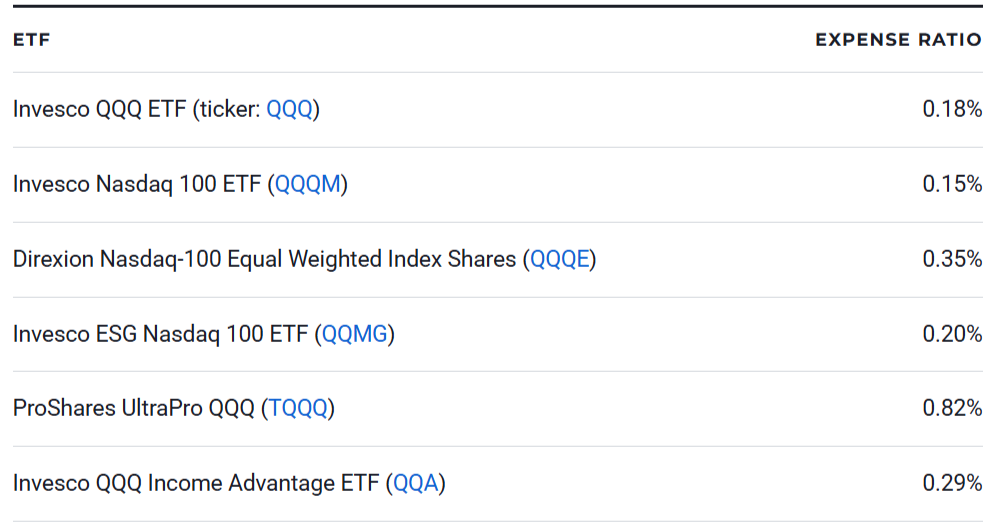
The Nasdaq-100 is a stock market index made up of the 100 largest Nasdaq composite stocks by market cap, excluding the financial sector. Here are six ETFs to buy that track the Nasdaq-100 index:
ETF
Invesco QQQ ETF (ticker: QQQ)
Invesco Nasdaq 100 ETF (QQQM)
Direxion Nasdaq-100 Equal Weighted Index Shares (QQQE)
Invesco ESG Nasdaq 100 ETF (QQMG)
ProShares UltraPro QQQ (TQQQ)
Invesco QQQ Income Advantage ETF (QQA)
Invesco QQQ ETF (QQQ)
The Invesco QQQ ETF is the largest Nasdaq-100 ETF by a very wide margin. The fund’s $435 billion in assets under management is several times larger than any other Nasdaq-100 ETF, and its average daily trading volume of 53 million shares also dwarfs the trading activity of any other Nasdaq-100 ETF. Needless to say, the QQQ ETF provides plenty of liquidity. Because the fund tracks the Nasdaq-100, its top holdings include Nvidia Corp. (NVDA), Apple Inc. (AAPL) and Microsoft Corp. (MSFT), and it’s heavily allocated to the technology sector with a roughly 60% weighting. It also has a 0.18% expense ratio.
Invesco Nasdaq 100 ETF (QQQM)
Long-term investors considering buying and holding the QQQ should also check out Invesco’s newer Nasdaq-100 fund, QQQM. Invesco launched QQQM in 2020, and it also tracks the Nasdaq-100. With around $82 billion in AUM and a daily average trading volume of 3.7 million shares, the QQQM fund is not nearly as liquid as the QQQ. However, investors can save a few dollars on fees given its expense ratio is just 0.15%. As a result of the fee difference, QQQM should tend to slightly outperform QQQ over long time horizons.
Direxion Nasdaq-100 Equal Weighted Index Shares (QQQE)
The Direxion QQQE ETF provides investors with a unique way to track the Nasdaq-100. Like the Nasdaq itself, the QQQ and the QQQM funds are market cap-weighted. However, the QQQE fund is equal-weighted. In other words, the index allocates 1% of its assets to each of the 100 constituents in the Nasdaq-100, regardless of their market caps. The QQQE fund has $1.2 billion in assets under management. The equal-weighted strategy hasn’t worked well in the past three years, and the QQQE fund, despite its market price rising 56% in that time, has lagged the market performance of QQQ (+114%) by nearly 60 percentage points. The QQQE fund has a 0.35% expense ratio.
Invesco ESG Nasdaq 100 ETF (QQMG)
QQMG offers investors another subtle twist on Invesco’s popular QQQ fund. The fund was created in 2021 to invest in Nasdaq-100 companies that also meet a set of standards related to environmental, social and governance (ESG) principles. For example, QQMG excludes stocks involved in certain businesses, including companies related to cannabis, alcohol, controversial weapons, military weapons, gambling, nuclear power, tobacco, and oil and gas. As a result, the fund only holds about 90 of the 100 Nasdaq-100 components. QQMG has a 0.2% expense ratio.
ProShares UltraPro QQQ (TQQQ)
For investors who want to take a more aggressive approach to investing in the Nasdaq-100, especially traders with a shorter investment horizon, TQQQ is a leveraged ETF designed to generate three times the daily returns of the Nasdaq-100. However, leveraged ETF investors should understand that triple the daily gains also means triple the daily losses on days the Nasdaq drops. Because leveraged ETFs are designed for short-term trading, hold derivatives that suffer from time loss decay and have aggressive turnover, they tend to underperform their targets significantly in the long term. That trend hasn’t always held true for TQQQ due to the incredible performance of the Nasdaq-100 itself over the last decade-plus. TQQQ has an expense ratio of 0.82%.
Invesco QQQ Income Advantage ETF (QQA)
This fund is a creative way for investors to gain exposure to the growth potential of the Nasdaq-100 while also generating significant income. QQA invests in securities designed to track the Nasdaq-100, but it also utilizes an options-based income strategy that involves equity-linked notes. As a result, QQA has an impressive dividend yield of almost 10% compared to a yield of well under 1% for QQQ. However, even with its massive dividend, the fund’s total return has lagged QQQ’s total return by about 6% since QQA was launched in 2024.