Starting in the early 1980s, long-term rates moved down in a steady trend that lasted until the summer of 2020. During that period, a bond investment strategy called “total return” became popular. Bill Gross, often called the “bond king” during his time at asset manager PIMCO, popularized the approach.
Total return went beyond clipping coupons and collecting interest. It focused on duration positioning, sector rotation and security selection to generate strong price performance from bonds.
At the same time, the traditional 60-40 stock-and-bond portfolio was becoming common among financial advisors and retirement investors. The 40% bond sleeve largely relied on another Wall Street innovation, the bond index fund, launched by Vanguard.
This represented the aggregate style of bond investing. As the name suggests, these funds hold a wide mix of Treasurys, corporate bonds, mortgage-backed securities (MBS) and other investment-grade assets.
Both total return strategies and aggregate bond indexing thrived during the long period of falling rates. Institutions captured attractive excess returns with the former, while retail investors gained a simple, low-volatility counterweight to equities via the latter.
That pattern started to shift in 2020 after unprecedented monetary stimulus in response to the COVID-19 pandemic. Long-term interest rates began to rise again as inflation accelerated and federal debt levels grew.
The change caused heavy losses for many bond portfolios. The Bloomberg U.S. Aggregate Bond Index fell 13% in 2022, with Gross even declaring the total return strategy “dead” in May 2024.
There is now a different interest rate environment for investors and advisors, but bond fund issuers have since adapted by expanding the number of options across credit quality, maturity and sector. Many bond funds are once again designed as income generators rather than just portfolio ballast.
“With yields still elevated, volatility lingering and central banks exercising caution, we believe bonds will continue to drive portfolio returns,” says JoAnne Bianco, partner and senior investment strategist at BondBloxx, an asset manager specializing in fixed-income products.
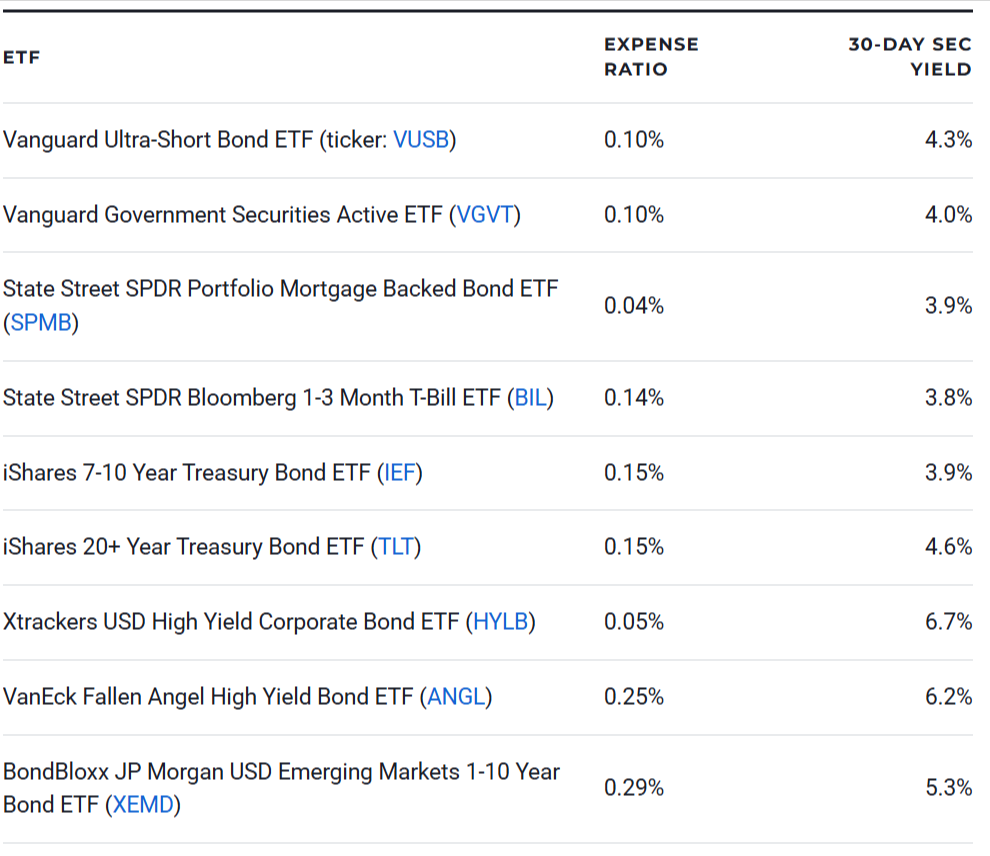
Here’s a look at nine of the best bond exchange-traded funds (ETFs) to buy for 2025:
ETF
Vanguard Ultra-Short Bond ETF (ticker: VUSB)
Vanguard Government Securities Active ETF (VGVT)
State Street SPDR Portfolio Mortgage Backed Bond ETF (SPMB)
State Street SPDR Bloomberg 1-3 Month T-Bill ETF (BIL)
iShares 7-10 Year Treasury Bond ETF (IEF)
iShares 20+ Year Treasury Bond ETF (TLT)
Xtrackers USD High Yield Corporate Bond ETF (HYLB)
VanEck Fallen Angel High Yield Bond ETF (ANGL)
BondBloxx JP Morgan USD Emerging Markets 1-10 Year Bond ETF (XEMD)
Vanguard Ultra-Short Bond ETF (VUSB)
“Investors have seen bond ETFs successfully weather multiple storms in the markets, including the pandemic sell-off in March 2020,” says John Croke, head of investor choice business activation at Vanguard. “Time and again, bond ETFs have demonstrated their resilience and liquidity for investors.”
Lower-risk-tolerance investors may find VUSB appealing. This actively managed bond fund emphasizes high credit quality and minimal interest rate sensitivity. While its net asset value (NAV) is not fixed like a money market fund, it still has minimal price volatility. VUSB currently pays a 4.3% 30-day SEC yield.
Vanguard Government Securities Active ETF (VGVT)
“Rich stock prices and attractive current yields are creating demand for bond ETFs – particularly actively managed ETFs – which helps investors who are seeking portfolio diversification with the additional profit potential that comes from active tilts,” says Stephen McFee, senior portfolio manager at Vanguard.
VGVT is one of Vanguard’s newer active bond ETFs. It generally targets Treasurys and agency-backed securities with an intermediate duration, with the goal of beating a Treasury index benchmark. VGVT currently pays a 4% 30-day SEC yield and charges a reasonable 0.1% expense ratio.
State Street SPDR Portfolio Mortgage Backed Bond ETF (SPMB)
“Mortgage-backed securities ETFs offer yields that are comparable to investment-grade corporate bonds, accompanied with high credit quality and monthly cash flows,” says Dave P. Francis, investment advisor and principal at Bartlett Wealth Management. SPMB offers low-cost exposure to these bonds.
With a 0.04% expense ratio, a $10,000 investment in SPMB can be expected to incur just $4 in annual fee drag. This ETF holds over 2,600 MBS issued by Ginnie Mae, Freddie Mac and Fannie Mae, which are rated AA1 and backed by the U.S. government. SPMB pays a 3.9% 30-day SEC yield.
State Street SPDR Bloomberg 1-3 Month T-Bill ETF (BIL)
“Often overlooked in bond ETFs is liquidity – the ability to buy or sell the security quickly, easily and without a large spread,” says Daniel Dusina, chief investment officer at Blue Chip Partners. “A bond ETF’s liquidity, for the most part, is driven by the liquidity of its underlying securities.”
The most liquid bonds in the market are Treasury bills. For this role, BIL offers excellent liquidity, with a 30-day median bid-ask spread of 0.01%. It currently shows a 3.8% 30-day SEC yield after accounting for a 0.14% expense ratio, although that yield will move lower if short-term interest rates decline.
iShares 7-10 Year Treasury Bond ETF (IEF)
“Intermediate-term bond ETFs invest in bonds with maturities between three and 10 years,” says Wes Moss, managing partner and chief investment strategist at Capital Investment Advisors. “They offer a balance between risk and return and are suitable for investors who have a medium-term horizon.”
IEF provides liquid and affordable exposure to the intermediate portion of the Treasury yield curve. The ETF charges a 0.15% expense ratio and currently pays a 3.9% 30-day SEC yield. It is one of the most popular intermediate maturity bond ETFs, with over $43 billion in assets under management.
iShares 20+ Year Treasury Bond ETF (TLT)
“Long-term bond ETFs invest in bonds with maturities of more than 10 years, are more sensitive to interest rate changes and may experience greater volatility in their returns,” Moss says. “They are suitable for investors who have a long-term investment horizon and can tolerate higher levels of risk.”
With an average duration of 15.6 years, TLT’s share price is very sensitive to fluctuations at the long end of the Treasury yield curve. However, the availability of an options chain opens up strategies for harnessing this volatility. For example, investors could sell TLT covered calls to generate more yield.
Xtrackers USD High Yield Corporate Bond ETF (HYLB)
Advances in ETF management have made it easier and cheaper to access exotic portions of the bond market, including high-yield corporate debt. HYLB is one example. It tracks the Solactive USD High Yield Corporates Total Market Index and charges a 0.05% expense ratio, which is very low for its category.
“HYLB also has a shorter duration than most peers and offers superior liquidity, as bonds in the portfolio must have a minimum $400 million float,” says Ben Spalding, head of fixed-income portfolio management for Xtrackers Americas at DWS Group. The ETF pays a 6.7% 30-day SEC yield.
VanEck Fallen Angel High Yield Bond ETF (ANGL)
One way to capture some of the old total return approach made popular by Bill Gross is to focus on “fallen angel” bonds. These are bonds that began as investment grade but were later downgraded to junk status. However, this can create room for future price appreciation as credit conditions improve.
Investors can target this segment via ANGL. The ETF charges a 0.25% expense ratio and tracks the ICE US Fallen Angel High Yield 10% Constrained Index. It currently pays a 6.2% 30-day SEC yield and has also delivered strong historical total returns, with a 9.8% annualized gain over the trailing three years.
BondBloxx JP Morgan USD Emerging Markets 1-10 Year Bond ETF (XEMD)
Another feature of bond ETFs is the ability to hold foreign fixed income in a liquid structure. XEMD is a good example, at a 0.29% expense ratio. This ETF tracks a portfolio of emerging market bonds that are denominated in U.S. dollars, which reduces currency risk for U.S.-based investors.
Most holdings are sovereign issuers from countries such as Saudi Arabia, Turkey, Mexico, Argentina and the United Arab Emirates. These markets carry higher credit risk, but that risk shows up in the fund’s enhanced income profile. XEMD currently pays a 5.3% 30-day SEC yield.