The best long-term exchange-traded funds, or ETFs, are different from the quirky and often unknown funds that make headlines because of big short-term gains. While tactical investments into a specific country or a targeted sub-sector of technology can pay off at the right time, they can also grossly underperform if and when the market moves against them.
Long-term investing is about diversification and the discipline to stick with it, regardless of the latest headlines. And the best long-term ETFs offer distinct yet complementary paths to building lasting wealth, across any market cycle.
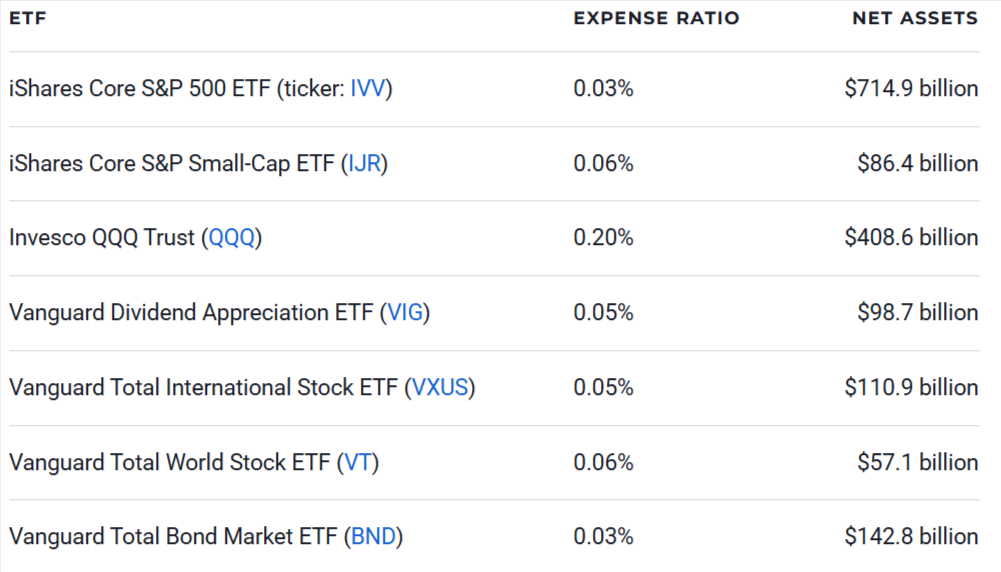
The following ETFs represent some of the most reliable options for long-term investors, and all have massive asset totals combined with reasonable expense ratios. However, each offers its own flavor to ensure it fits in with your personal investment strategy.
ETF
1、iShares Core S&P 500 ETF (ticker: IVV)
2、iShares Core S&P Small-Cap ETF (IJR)
3、Invesco QQQ Trust (QQQ)
4、Vanguard Dividend Appreciation ETF (VIG)
5、Vanguard Total International Stock ETF (VXUS)
6、Vanguard Total World Stock ETF (VT)
7、Vanguard Total Bond Market ETF (BND)
iShares Core S&P 500 ETF (IVV)
This iShares offering is the second-largest ETF on Wall Street by net assets, following the well-known Vanguard S&P 500 ETF (VOO)。 Both track the S&P 500 index, which comprises the largest publicly traded U.S. companies, and they both charge a very low 0.03% expense ratio. IVV includes all 500 S&P components, led by trillion-dollar tech stocks Apple Inc. (AAPL) and Microsoft Corp. (MSFT)。 Its simplicity, low cost and broad exposure make it a cornerstone holding for most diversified portfolios and one of the premier long-term ETFs for investors seeking steady market exposure.
iShares Core S&P Small-Cap ETF (IJR)
Index provider S&P Dow Jones Indices divides the top 1,500 domestic corporations into three tiers: the S&P 500 (large cap), S&P 400 (mid cap) and S&P 600 (small cap)。 And this sister iShares ETF offers exposure to the S&P 600 index, which tracks small-cap U.S. companies. Unlike large-cap indexes dominated by big technology firms, IJR has almost as much weighted toward financials and industrials as the tech sector, with about 17% of total assets in each. Top positions at present include digital memory specialist SanDisk Corp. (SNDK), building and infrastructure firm Sterling Infrastructure Inc. (STRL) and HVAC firm SPX Technologies Inc. (SPXC) as representative examples. For investors seeking long-term growth potential among emerging businesses, IJR provides an efficient vehicle for small-cap exposure.
Invesco QQQ Trust (QQQ)
This fund tracks the Nasdaq-100 Index, which is composed of the largest non-financial companies listed on the Nasdaq exchange. As a result, its portfolio is heavily concentrated in technology, with more than 55% of assets in this sector and top holdings that include Apple, Microsoft, Nvidia Corp. (NVDA) and Amazon.com Inc. (AMZN)。 What’s more, its market-cap-weighted structure means about half of QQQ’s assets are allocated in the top 10 positions alone. That is admittedly less diversification than other ETFs on this list, but it could fit with investors who actually prefer to be “overweight” in tech to pursue the sector’s long-term growth potential.
Vanguard Dividend Appreciation ETF (VIG)
This Vanguard fund is the largest ETF dedicated to dividend growth investing. It focuses on large-cap companies with a consistent record of increasing dividends annually. And while its current 30-day SEC yield of 1.6% may seem modest, the power of compounding dividend growth over time makes VIG an attractive long-term holding. Take top holding JPMorgan Chase & Co. (JPM), which has seen dividends surge from 40 cents per share at the beginning of 2015 to $1.50 as of its latest quarterly distribution. For investors prioritizing stability and steady income growth, VIG represents a disciplined and proven approach via stocks like these that grow payouts over time.
Vanguard Total International Stock ETF (VXUS)
Diversification remains a key principle of sound long-term investing. And as the name implies, the Vanguard Total International Stock ETF offers exposure to the totality of the global stock market about 8,700 stocks. There’s an interesting quirk, though – these are only from markets outside the U.S. As a result, the VXUS portfolio includes well-established companies such as tech giant Taiwan Semiconductor Manufacturing Co. Ltd. (2330.TW), Swiss health care giant Novartis AG (NOVN.SW) and U.K. financial leader HSBC Holdings PLC (HSBA.L)。 Leading regional allocations include Japan (15%), China (10%) and the U.K. (9%)。 For investors seeking to balance domestic holdings with international exposure in their portfolio, VXUS offers a good complementary holding.
Vanguard Total World Stock ETF (VT)
For investors who prefer to avoid picking favorites, this Vanguard fund offers one of the best long-term ETFs to buy for an all-encompassing solution. VT tracks over 9,900 stocks across all market capitalizations and geographies, providing broad exposure to both developed and emerging economies. Unlike the prior fund, U.S. equities are included and account for about 60% of total assets. The remaining share encompasses leading corporations from Europe, Asia and other regions. This “one-stop” approach makes VT a convenient and balanced option for long-term investors seeking worldwide diversification.
Vanguard Total Bond Market ETF (BND)
After all this discussion of diversification, it’s important to acknowledge the universe of long-term investments that exist outside of equity markets. Bonds are at the top of that list, and they play an essential role in managing risk and providing income stability. And among bond ETFs, BND is among the most respected. It stands among the 10 largest ETFs globally of any investing flavor, and it offers exposure to more than 11,000 investment-grade bonds in a single holding. Its portfolio spans U.S. Treasurys, corporate bonds from issuers such as Bank of America Corp. (BAC) and securitized mortgage-backed securities. Right now, about 50% of assets are invested in government bonds, 25% are in corporate debt, and most of the remainder are in securitized instruments. Currently, BND delivers a yield of about 4.1% – more than double the average dividend yield of S&P 500 stocks. This ETF could serve as a significant source of long-term income as well as stability.