If your goal is to generate more income from your investment portfolio, there are a few approaches depending on the underlying asset class.
For bonds, the logic is fairly intuitive. All else being equal, the lower the credit quality, the higher the yield. This is why investment-grade corporate bonds tend to yield more than Treasurys of equivalent maturity, and junk bonds tend to yield more than both. None of this is a free lunch. The extra yield is compensation for a greater chance that the borrower will not be able to pay you back in full or on time.
For stocks, the mechanics are more nuanced. Stocks do not come with a built-in credit rating system, and companies have wide discretion in how they return value to shareholders. For instance, Apple Inc. (ticker: AAPL) leans heavily on stock buybacks. Buybacks reduce the number of shares outstanding and can boost earnings per share, but they do not put cash directly in an investor’s pocket on a set schedule.
On the other hand, companies that pay high dividends often do so because they can’t easily reinvest at returns above their cost of capital, so they distribute it for shareholders to deploy elsewhere. This is common among mature firms such as tobacco giant Altria Group Inc. (MO), which currently pays a 6.6% dividend yield. The trade-off is that these companies may have less reinvestment-driven growth ahead.
If dividends still can’t provide the level of income you want, investors can implement an options overlay, specifically by selling covered calls. This means you hold 100 shares of a stock and agree to potentially sell those shares at a preset price, known as the strike, by a preset date, known as the expiration. In exchange, you collect cash up front, called the premium.
Whether that premium compensates you fairly for the foregone upside depends on factors like the strike price, time until expiration and volatility. When volatility is high, uncertainty is high, and option buyers are willing to pay more for protection or upside. You can think of it like writing an insurance policy. Higher perceived risk means a higher premium.
Covered call strategies are now widely available inside exchange-traded funds (ETFs)。 They apply the option-selling strategy across a diversified portfolio of stocks, bonds, commodities and even cryptocurrencies. The result is a hands-off, capital-efficient way to turn future upside into immediate cash flow, often paid monthly or even weekly.
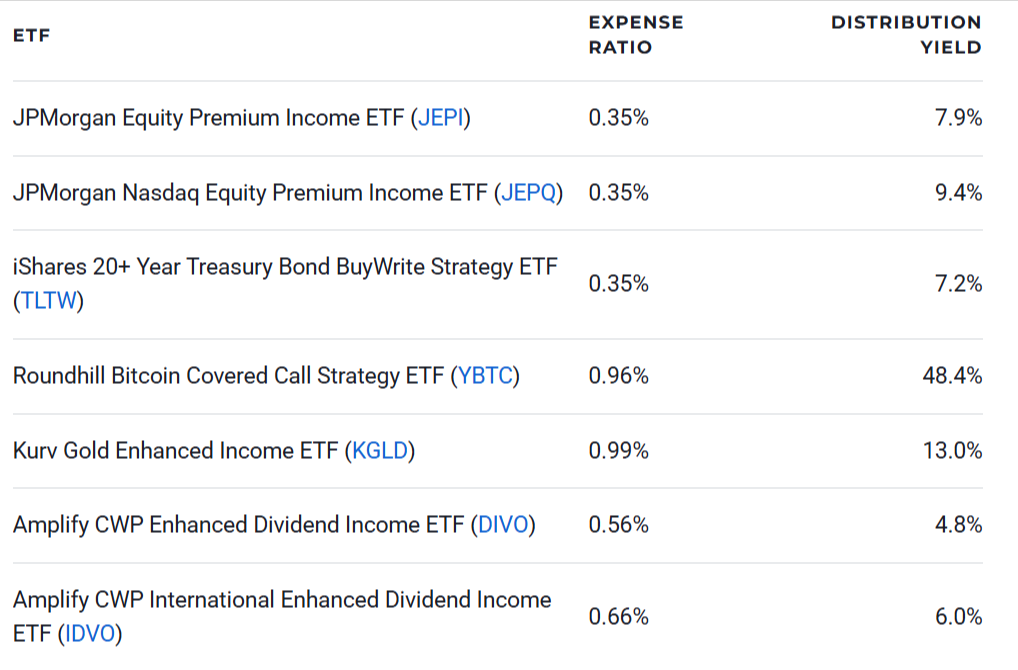
Here are seven of the best covered call ETFs to buy right now:
ETF
JPMorgan Equity Premium Income ETF (JEPI)
JPMorgan Nasdaq Equity Premium Income ETF (JEPQ)
iShares 20+ Year Treasury Bond BuyWrite Strategy ETF (TLTW)
Roundhill Bitcoin Covered Call Strategy ETF (YBTC)
Kurv Gold Enhanced Income ETF (KGLD)
Amplify CWP Enhanced Dividend Income ETF (DIVO)
Amplify CWP International Enhanced Dividend Income ETF (IDVO)
JPMorgan Equity Premium Income ETF (JEPI)
“With a covered call ETF, the stock purchase, portfolio management and call-writing decisions are left to a professional,” says Robert Johnson, professor of finance at Creighton University’s Heider College of Business. “By buying a covered call ETF, one doesn’t have to continuously monitor both the stock and options markets.” This is especially true if the covered call ETF is actively managed.
JEPI is a good example. Managed by J.P. Morgan veteran Hamilton Reiner, this fund is the most popular active ETF, with $41 billion in assets under management. It combines a portfolio of defensive large-cap stocks selected for low volatility with an S&P 500 index covered call strategy via equity-linked notes (ELNs)。 JEPI currently pays a 7.2% 30-day SEC yield and charges a reasonable 0.35% expense ratio.
JPMorgan Nasdaq Equity Premium Income ETF (JEPQ)
JEPQ is JEPI’s more aggressive counterpart. This ETF uses the Nasdaq-100 index as its selection universe, which provides a tilt toward large-cap growth stocks and technology sector stocks. Then, it uses a similar ELN allocation to provide exposure to a Nasdaq-100 index covered call overlay. Because the Nasdaq-100 is more volatile than the S&P 500, JEPQ pays a higher 9.9% 30-day SEC yield.
JEPQ has historically been a strong outperformer, with a trailing-three-year annualized total return of 24.5%. This ETF beat out most of its 77 peers in the Morningstar “derivative income” category, earning it a five-star rating for superior risk-adjusted returns. However, tax efficiency isn’t the best, given the use of ELNs produces ordinary income distributions. JEPQ also charges a 0.35% expense ratio.
iShares 20+ Year Treasury Bond BuyWrite Strategy ETF (TLTW)
The iShares 20+ Year Treasury Bond ETF (TLT) is one of the most widely traded bond ETFs, known for its high daily volume and tight bid-ask spread. It also has an active options market with weekly expirations, allowing investors to sell covered calls for extra income. For those who prefer not to manage that process themselves, TLTW offers a hands-off alternative with monthly distributions.
TLTW passively tracks the Cboe TLT 2% OTM BuyWrite Index, which systematically sells one-month call options that are 2% out-of-the-money on TLT. This strategy aims to cover 100% of the underlying holdings, exchanging most upside potential for a steady stream of income. Thanks to TLT’s inherent volatility, TLTW currently pays a 7.2% distribution yield based on its most recent monthly payout.
Roundhill Bitcoin Covered Call Strategy ETF (YBTC)
The rule of thumb that higher volatility leads to higher options premiums is taken to the extreme with Bitcoin covered call ETFs like YBTC. This fund’s most recent payout translates to a 48.4% distribution yield. It is also one of the few covered call ETFs to pay on a weekly basis. However, investors should note the high 0.96% expense ratio and complex structure full of derivatives.
To achieve its strategy, YBTC uses a mix of put and call options on spot Bitcoin ETFs to first replicate a long Bitcoin position, known as a synthetic stock, and then sell covered calls on top of it. This setup means the ETF doesn’t actually hold Bitcoin directly – just cash collateral and derivatives. Investors earn high income in exchange for giving up most upside potential, but retain full downside exposure.
Kurv Gold Enhanced Income ETF (KGLD)
Gold has been in a strong bull market this year, but unlike stocks or bonds, it doesn’t generate income – its gains come entirely from price appreciation. Investors seeking yield from gold typically turn to gold miners that pay dividends or sell covered calls on spot gold ETFs. The latter approach can be automated through KGLD, a new ETF that uses collateral to back options sold on several spot gold ETFs.
“Gold has long proven to be a hedge against risk and inflation, yet many investors avoid it because it doesn’t generate cash flow,” said Howard Chan, founder and CEO of Kurv Investment Management. “Kurv’s institutional options strategies let investors capture gold’s diversification benefits while earning income.” KGLD currently pays a 13% distribution yield and charges a 0.99% expense ratio.
Amplify CWP Enhanced Dividend Income ETF (DIVO)
Some covered call ETFs focus purely on maximizing yield at the cost of total return, but others, like DIVO, take a more balanced approach. DIVO’s 4.8% distribution yield may seem modest compared to peers, but its disciplined, selective strategy has produced one of the best risk-adjusted return profiles among 77 derivative income funds, earning it a five-star Morningstar rating alongside JEPQ.
“Unlike most index-based covered call ETFs that write calls robotically at set times, DIVO’s actively managed approach not only allows the manager to monitor holdings each day to ensure they meet quality and valuation metrics, but it also provides the flexibility to take advantage of timely opportunities by writing calls on individual stocks,” says Christian Magoon, CEO of Amplify ETFs.
Amplify CWP International Enhanced Dividend Income ETF (IDVO)
Many covered call ETFs focus exclusively on U.S. stocks due to the deep liquidity of both single-stock and index options like those tied to the S&P 500 or Nasdaq-100. However, certain international equities, including American depositary receipts, also have sufficient options liquidity to support similar strategies. IDVO applies a similar rule set as DIVO but to foreign dividend-paying stocks.
“IDVO owns high-quality, dividend-paying international stocks while maintaining the ability to tactically write covered calls on individual stocks,” Magoon says. “Foreign stock exposure will further diversify a U.S. stock portfolio and perhaps increase total return potential.” This international ETF currently pays a 6% distribution yield with monthly payouts, and charges a 0.66% expense ratio.