Investing is a marathon, not a sprint. So while the stock market has been choppy in recent months, the best strategies tend to involve buying long-term ETFs to hold over years rather than weeks or months.
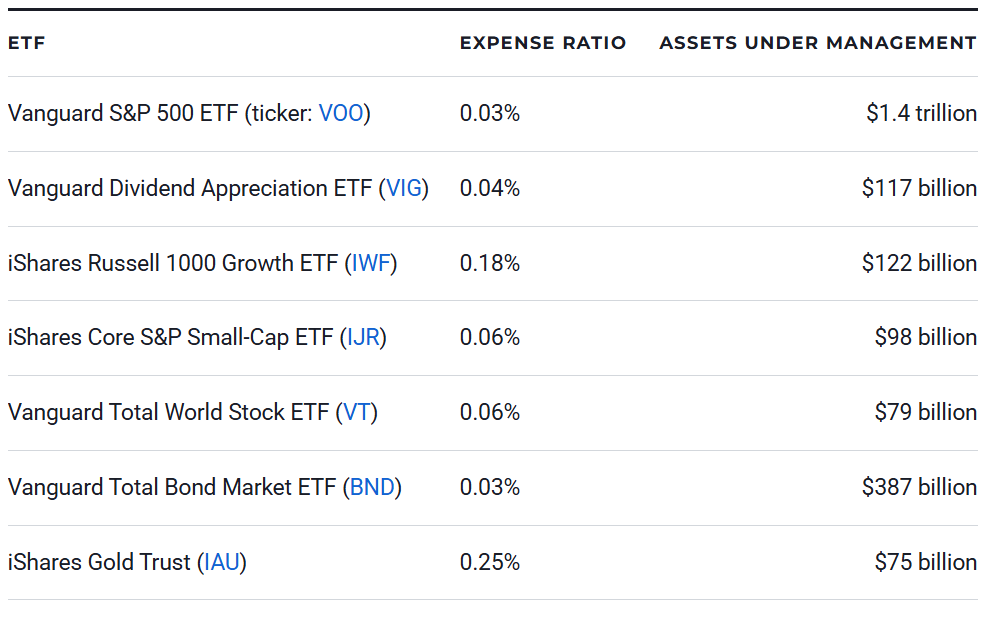
These funds provide low cost structures and diversified portfolios that will help investors build wealth over the long haul. They are the best long-term ETFs to buy and hold based on their size, with greater than $70 billion in assets each, as well as low cost structures to help you keep more of your returns rather than pay earnings back out via fees.
The ETFs on this list are designed to deliver consistent performance, and they represent foundational investments for almost any portfolio:
ETF
Vanguard S&P 500 ETF (ticker: VOO)
Vanguard Dividend Appreciation ETF (VIG)
iShares Russell 1000 Growth ETF (IWF)
iShares Core S&P Small-Cap ETF (IJR)
Vanguard Total World Stock ETF (VT)
Vanguard Total Bond Market ETF (BND)
iShares Gold Trust (IAU)
Vanguard S&P 500 ETF (VOO)
Though the S&P 500 index started the year with some trouble, its recent recovery since the end of March shows the benefit of staying the course and not falling victim to the doom and gloom in the headlines. And if you want to stick with the S&P as the best way to play the stock market at large, VOO remains a go-to option for long-term investors. This ETF offers a straightforward strategy by tracking the S&P 500 – home to the most prominent blue-chip companies. Investors get exposure to household names like JPMorgan Chase & Co. (JPM), Microsoft Corp. (MSFT) and Johnson & Johnson (JNJ)。 If you’re looking to invest in the U.S. stock market for the years ahead, this is one of the most efficient ways to do so.
Vanguard Dividend Appreciation ETF (VIG)
Dividends are a powerful way for investors to tap into long-term income without relying on the direct sale of their holdings. The largest dividend-focused ETF on the market, VIG invests in large-cap stocks with a strong track record of growing dividends annually. This makes it a reliable long-term holding, featuring blue-chip leaders like Broadcom Inc. (AVGO), Eli Lilly and Co (LLY) and Exxon Mobil Corp. (XOM)。 With about 340 dividend-paying companies in its portfolio, VIG is highly diversified and focused on stability. But while it may not have as much growth as other options, the consistent dividend payouts are a great hedge against market downturns as well as a great income stream.
iShares Russell 1000 Growth ETF (IWF)
For investors who are interested in a bit more growth in their portfolio, this iShares growth ETF takes the largest 1,000 stocks that make up the Russell 1000 index of large-cap and mid-sized stocks and then selects the top 400 or so based on growth criteria. That includes fundamental metrics such as sales growth, profit margin and earnings potential. The result is a focused list that is more than 50% in the tech sector, with leaders like Nvidia Corp. (NVDA) and Apple Inc. (AAPL) a prominent part of the portfolio. Less than 2% of all assets are allocated across more value-oriented sectors like utilities, energy, real estate and materials. If you are looking for long-term growth, IWF is a well-established and cost-effective way to do so.
iShares Core S&P Small-Cap ETF (IJR)
A different approach to long-term ETFs with a growth bent is IJR, which focuses on the S&P 600 index of small-cap stocks. The average market cap of all holdings is just $3 billion, giving this fund a slightly higher risk profile but also potential for big returns as these up-and-coming companies have a long runway ahead of them. Top stocks right now include networking technology firm Viavi Solutions Inc. (VIAV) and testing and measurement specialist FormFactor Inc. (FORM)。 Portfolio allocation is predominantly in financial services (17%), industrials (15%) and technology (14%)。
Vanguard Total World Stock ETF (VT)
One of the big themes of the last year or so has been the general outperformance of international stocks compared with domestic markets, highlighting the importance of geographic diversification. VT offers broad global exposure with nearly 10,000 holdings across both U.S. and international markets. While the ETF is weighted toward large-cap names like Apple, it also provides diversified exposure across regions, including Japan and the U.K. Roughly 60% of the portfolio is U.S.-based. For long-term investors looking to participate in global equity growth without picking sectors or regions, this ETF is a compelling option thanks to its inclusion of leading firms outside the usual U.S. leaders.
Vanguard Total Bond Market ETF (BND)
As the name implies, BND offers access to the broad U.S. bond market. While there’s talk of near-term interest rate cuts, it’s important to remember that 10-year Treasury yields crashed to a historic low of 0.51% in 2020 during the worst of the pandemic – so by comparison, bond markets are much more attractive than just a few years ago, with the 10-year Treasury currently yielding about 4.3%. More importantly, BND provides long-term diversification across asset classes, delivering more stable and lower-risk returns over time. With a diversified approach that includes government debt and investment-grade corporate bonds from leading companies, this Vanguard ETF is a strong addition to any long-term portfolio.
iShares Gold Trust (IAU)
Gold has outperformed both stocks and bonds over the last 12 months with a tremendous return of 50%. And, thanks to its low-risk and inflation-resistant characteristics, momentum doesn’t seem to be slowing down. While it doesn’t offer the explosive growth potential of tech stocks, gold provides a safe haven in volatile times and a valuable alternative asset for long-term investors seeking diversification. IAU is one of the largest and most cost-effective ways to gain direct exposure to gold, tracking the price of physical bullion rather than gold mining stocks or other derivatives. Shares of this long-term ETF may be volatile and uncorrelated to stocks, but gold remains an important part of many low-risk portfolios to provide peace of mind in the years to come.