How do you combine illiquid assets – investments that aren’t marked to market daily and don’t have a steady roster of buyers and sellers – with a public vehicle designed to trade freely for retail investors?
One possible solution is the Destiny Tech 100 (ticker: DXYZ), a closed-end fund (CEF) listed on the New York Stock Exchange. Its mandate is to build a portfolio of 100 venture-backed private companies.
Today, that portfolio includes 24 holdings, featuring headline-grabbing technology and artificial intelligence (AI) names like SpaceX, OpenAI, Revolut and Kraken. On the surface, that sounds compelling. In practice, the structure has been far less friendly to retail investors.
DXYZ’s headline 2.5% management fee is already high, but it understates the true cost of ownership for investors. In its 2025 semi-annual report for the six months ended June 30, the fund disclosed an expense ratio of 7.15% of average net assets.
Worse, because it is a CEF, DXYZ does not continuously create or redeem shares the way open-ended exchange-traded funds (ETFs) do. Without an arbitrage mechanism to keep market prices aligned with net asset value (NAV), shares can trade far above or below what the underlying portfolio is worth.
That mismatch has historically been extreme. According to data from CEF Connect, DXYZ’s share price traded at a peak premium of more than 738% to its last reported NAV over the past year, due to high demand. Even after narrowing recently, DXYZ still traded at a 157% premium as of Feb. 5.
There is, however, a workaround now with ETFs. “ETFs operate under liquidity risk management rules (SEC Rule 22e-4), which cap illiquid investments at 15% of net assets,” says Derek Yan, senior investment strategist at KraneShares. “Illiquid securities are defined as those that cannot be reasonably sold within seven days without materially impacting price.”
That allowance has opened the door to more ETF-based approaches to private equity exposure – still complex and fee-heavy, but far more transparent and liquid than CEFs.
“The ETF creation and redemption mechanism continues to function through authorized participants, while secondary market liquidity is supported by the fund’s publicly traded holdings,” Yan explains. “Some ETFs utilize special purpose vehicles (SPVs) to access private securities; however, direct ownership may offer advantages in transparency, fee efficiency and alignment with underlying valuation.”
Other ETFs take a different route by holding shares of publicly listed private asset managers. This can help investors participate in the economics of private equity through management fees, carried interest and balance-sheet investments, rather than direct ownership of private companies themselves.
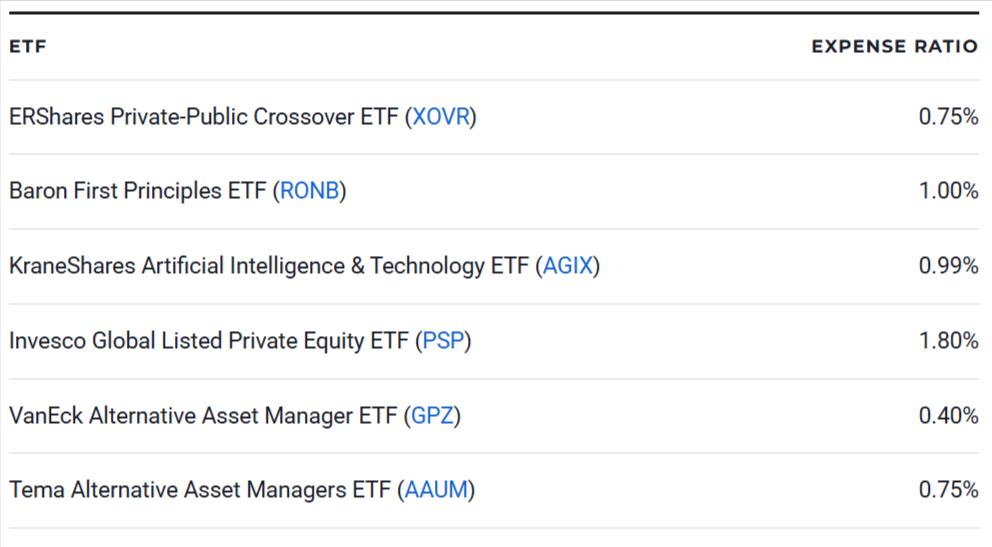
Here are six of the best ETFs offering private equity exposure in 2026:
ERShares Private-Public Crossover ETF (XOVR)
One option for private equity exposure is XOVR. Most of the portfolio tracks the Entrepreneur 30 Total Return Index, which filters for U.S. large-cap companies using an innovation-based screen. What sets the ETF apart, however, is its roughly 9.3% allocation to SpaceX, achieved through an SPV. This is a separate legal entity created to hold private shares of SpaceX on behalf of the ETF.
However, XOVR’s use of an SPV has also drawn scrutiny. Analyst Jeffrey Ptak of Morningstar has criticized XOVR’s SpaceX position in an article titled “How to Manage an ETF … Right Into a Corner,” raising concerns around liquidity management, how private shares are marked inside a daily-traded ETF and the heavy marketing emphasis placed on that private exposure. XOVR charges a 0.75% expense ratio.
Baron First Principles ETF (RONB)
While some private-equity-adjacent ETFs rely on indexes, not all take a passive approach. A good example is RONB. This ETF is actively managed, giving its portfolio managers discretion to allocate across both public and private companies they believe fit Baron’s growth framework. RONB’s largest public holding is Tesla Inc. (TSLA) at roughly 13% of assets, alongside a meaningful allocation to SpaceX.
The portfolio is tilted toward consumer discretionary, financials and information technology stocks. RONB is a relatively new entrant, having launched in December, but it has already accumulated just over $70 million in assets under management, clearing the often-cited $50 million threshold for long-term ETF viability. However, RONB charges a high 1% expense ratio.
KraneShares Artificial Intelligence & Technology ETF (AGIX)
“AGIX combines a public equity index sleeve of AI and technology leaders with direct holdings in private pre-IPO companies such as SpaceX and Anthropic,” Yan says. “AGIX also appears directly on the capitalization table of private issuers rather than investing through intermediary structures like SPVs, meaning the ETF is registered as an actual shareholder.” /AGIX currently charges a 0.99% expense ratio.
SpaceX and Anthropic currently sit at 3.5% and 2.7% of AGIX’s portfolio, respectively. “Following Elon Musk’s merger, AGIX’s previous xAI holdings have been converted into shares of SpaceX, further strengthening the fund’s exposure,” Yan says. “Meanwhile, Anthropic continues to gain global attention through breakthroughs in coding capabilities and agentic workflow automation.”
Invesco Global Listed Private Equity ETF (PSP)
“PSP tracks the Red Rocks Globally Listed Private Equity Index, which invests in 40 to 75 listed private equity companies,” says Rene Reyna, head of thematic and specialty product ETF strategy at Invesco. “The common business interest of these companies is the buying and selling of others – while the companies in PSP are publicly listed and traded, they in turn own over 1,000 private businesses.”
While not the primary focus of PSP, a portion of the portfolio is allocated to business development companies (BDCs)。 BDCs are pass-through vehicles that primarily lend to or invest in middle-market private companies. A defining feature of BDCs is their above-average income profile, which, while incidental to PSP’s strategy, helps support the ETF’s above-average 2.6% 30-day SEC yield.
VanEck Alternative Asset Manager ETF (GPZ)
GPZ tracks the MarketVector Alternative Asset Managers Index. The ETF holds a diversified basket of publicly traded firms that specialize in private equity, venture capital, private credit, real estate and infrastructure, for a 0.4% expense ratio. Top holdings investors may recognize include Brookfield Corp. (BN), Blackstone Inc. (BX), KKR & Co. Inc. (KKR) and Apollo Global Management Inc. (APO)。
With GPZ, the thesis is less about the outperformance of one or two private companies and more about the structural growth of private equity as an asset class. In effect, investors owning this ETF are betting that private markets will continue to take share from public markets, translating into higher assets under management, recurring fee revenue and long-term earnings growth for the firms that sit at the center.
Tema Alternative Asset Managers ETF (AAUM)
Similar to GPZ, AAUM targets companies tied to private equity, private credit, infrastructure, real estate and venture capital. Unlike GPZ, however, AAUM is actively managed. While there is overlap in familiar names like Apollo Global Management and Brookfield, the fund also includes more under-the-radar firms such as Hamilton Lane Inc. (HLNE), which specializes in private markets advisory.
From a sector perspective, AAUM is overwhelmingly classified as financials, which is a result of Global Industry Classification Standard conventions. The implication for investors is that AAUM’s performance can be closely tied to how the financial sector is treated by markets overall, meaning the ETF can also face amplified downside if the larger banks that dominate the sector fall out of favor.