Broadly speaking, there are two ways to invest in semiconductors as a retail investor in 2026, and the difference comes down to style.
One approach commonly used by active portfolio managers is bottom-up investing. This method starts at the company level and is driven by fundamentals.
Investors analyze unit economics, management strategy, balance sheets and cash-flow generation, then form expectations for how those factors may translate into shareholder-enhancing outcomes such as buybacks, dividends, reinvestment in research and development, or acquisitions.
The goal is to identify cases where market expectations or consensus analyst forecasts appear mispriced, creating an opportunity for a specific company to outperform both the sector and the broader market. This process is inductive, building a broader investment thesis from detailed company-level analysis.
That level of analysis can be demanding. It requires a solid understanding of accounting and corporate finance, along with operational knowledge that varies widely across the semiconductor industry.
An alternative is a top-down approach. Instead of focusing on individual companies, this style looks at semiconductors as an industry and evaluates how broader forces may influence its overall direction.
These factors include monetary policy, capital spending cycles, supply chain dynamics, geopolitical developments and secular demand from adjacent industries like artificial intelligence hyperscalers and cloud data centers.
“The semiconductor industry is undergoing its biggest shift in decades,” says Tejas Dessai, director of thematic research at Global X ETFs. “AI is reshaping computing, creating demand for specialized hardware while displacing legacy components.”
Investors with a bullish top-down view are looking for catalysts that could support the sector as a whole, accepting that while some companies may lag, the strongest players often drive strong overall returns.
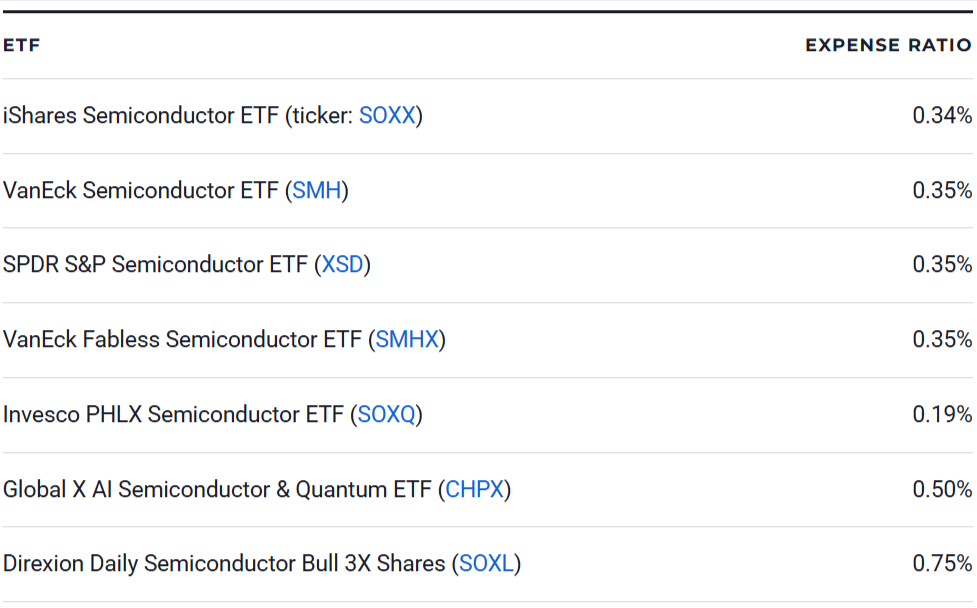
Here are seven of the best semiconductor exchange-traded funds (ETFs) to buy today:
ETF
iShares Semiconductor ETF (ticker: SOXX)
VanEck Semiconductor ETF (SMH)
SPDR S&P Semiconductor ETF (XSD)
VanEck Fabless Semiconductor ETF (SMHX)
Invesco PHLX Semiconductor ETF (SOXQ)
Global X AI Semiconductor & Quantum ETF (CHPX)
Direxion Daily Semiconductor Bull 3X Shares (SOXL)
iShares Semiconductor ETF (SOXX)
“The potential benefits of investing in semiconductor ETFs include exposure to a high-growth industry with strong fundamentals, diversification across multiple companies in the industry and the potential for long-term capital appreciation,” says Sean August, CEO of August Wealth Management Group. Opting for a semiconductor ETF like SOXX helps mitigate the intense competition risk present in the industry.
SOXX tracks 30 U.S.-listed semiconductor companies represented by the NYSE Semiconductor Index. The top holdings are Nvidia Corp. (NVDA), Advanced Micro Devices Inc. (AMD), Micron Technology Inc. (MU) and Broadcom Inc. (AVGO)。 It charges a 0.34% expense ratio, which amounts to $34 a year in fee drag for a $10,000 investment. Liquidity is also excellent thanks to a 0.02% 30-day median bid-ask spread.
VanEck Semiconductor ETF (SMH)
“Semiconductors continue to be a cornerstone for innovation, especially as AI models grow more powerful,” says Nick Frasse, product manager at VanEck. “We’re closely watching compute and scaling laws – the trend of continuously increasing processing power – which strongly supports sustained semiconductor demand.” SMH is VanEck’s flagship ETF for semiconductor exposure.
This ETF differs from SOXX by tracking the MVIS US Listed Semiconductor 25 Index. The result is a slightly narrower basket of companies that is also significantly more top-heavy, with Nvidia alone accounting for 20% of SMH. However, this concentration has driven strong historical performance for SMH, with a 10-year annualized total return of 30.3%. SMH also charges a 0.35% expense ratio.
SPDR S&P Semiconductor ETF (XSD)
“When looking for semiconductor ETFs, investors should consider factors such as the expense ratio, the underlying index or benchmark, the fund’s holdings and diversification strategy, and the ETF’s historical performance,” August says. “It is also important to assess the fund’s liquidity to ensure that it is easy to buy and sell.” Investors looking for an established, less top-heavy alternative to SMH can consider XSD.
XSD remains well-capitalized with $1.7 billion in assets under management (AUM), and it matches SMH and SOXX in terms of fees, with a 0.35% expense ratio. However, XSD differs by being equally weighted instead of market-cap weighted. As a result, XSD’s top holdings are not dominated by the big chipmakers. Instead, small- and mid-cap semiconductor stocks that outperform in between rebalancing cycles get a chance to shine.
VanEck Fabless Semiconductor ETF (SMHX)
“Geopolitical tensions and tariffs have made semiconductor supply chains more complicated, driving companies toward diversifying and localizing manufacturing,” Frasse explains. Notably, export controls imposed by the U.S., and the selective easing or renewal of those controls for countries like China, can either help or hurt investors. A fabless semiconductor ETF like SMHX can help mitigate this risk.
“The semiconductor industry continues to evolve rapidly, driven by fabless companies that prioritize chip design and innovation while outsourcing production,” Frasse notes. “This model allows firms like Nvidia to invest heavily in research and development, keep capital expenditures lower, and remain more agile as market conditions change.” SMHX charges a 0.35% expense ratio, the same as SMH.
Invesco PHLX Semiconductor ETF (SOXQ)
“While certain segments of the semiconductor market, like memory, may be facing pressure due to supply concerns, the longer-term growth potential driven by advancements in AI, autonomous driving and high-performance computing remains strong,” says Rene Reyna, head of thematic and specialty product strategy at Invesco. Semiconductor investors prioritizing low fees may like SOXQ.
This ETF tracks the 30 largest U.S.-listed semiconductor companies represented by the PHLX Semiconductor Sector Index. The top holdings for SOXQ are very similar to that of SOXX, albeit in slightly different weights. However, SOXQ beats SOXX in terms of fees thanks to a 0.19% expense ratio. For a $10,000 investment, this works out to a difference of $19 versus $34 a year in fee drag.
Global X AI Semiconductor & Quantum ETF (CHPX)
“The semiconductor shift is most visible on three fronts: the transition from general-purpose processors to AI-optimized chips, the use of high-bandwidth memory to handle AI’s data intensity and the rise of ultra-fast interconnect solutions that bind AI servers together,” Dessai explains. Global X launched CHPX in the U.S. market in September to complement its existing thematic AI ETFs.
“CHPX provides exposure to companies across the entire global compute stack, from AI semiconductors to data center equipment, power infrastructure and quantum technologies,” Dessai says. “This offers a more holistic view of the long-term computing ecosystem rather than a narrow slice of it.” The ETF currently has just over $13 million in AUM and charges a 0.5% expense ratio.
Direxion Daily Semiconductor Bull 3X Shares (SOXL)
“Semiconductors are the engine powering the AI revolution and the modern global economy,” says Mo Sparks, chief product officer at Direxion. “Be it through trillion-dollar market caps, earnings surprises and misses, tariffs, or broader geopolitical events, today’s traders have plenty of catalysts and volatility to guide their daily conviction.” A short-term bullish view on semiconductors can be expressed via SOXL.
This leveraged ETF is designed to deliver a daily price return three times that of the benchmark index used by SOXX. “Belief that AI and semiconductors will continue to drive economic expansion, paired with recent earnings that spotlighted continued opportunity and gigantic capex spending from technology companies, is likely all the conviction a bullish trader needs,” Sparks says.