9 of the Best Bond ETFs to Buy for 2026
For any pooled investment vehicle, whether a mutual fund or an exchange-traded fund (ETF), innovation is constant. Product design often revolves around improving tax efficiency, lowering fees and creating more precise exposure to specific asset classes or themes.
Another challenge comes up consistently: figuring out how to package increasingly complex or exotic underlying assets into a liquid structure that retail investors can trade easily. Nowhere has that evolution been more visible than in bond ETFs over the past few years.
When they first debuted in 2002, bond ETF choices were fairly simple. Investors typically selected low-cost funds that tracked passive benchmarks made up of U.S. Treasurys, mortgage-backed securities (MBS) or investment-grade corporate bonds.
Those options still exist, but they no longer define the full landscape. Growing demand for yield, combined with strategic pressure inside asset management firms, has pushed product teams, lawyers and regulators to explore new corners of the fixed-income market.
The result has been a steady expansion of more exotic bond ETFs. Some of the most extreme examples are funds seeking exposure to private credit.
These are loans made directly to companies outside public markets. They are often customized, illiquid and difficult to value. Historically, private credit was accessible only through private funds with high-net-worth requirements or large minimum investments.
That barrier has begun to shift. Under Securities and Exchange Commission Rule 22e-4, an ETF can hold up to 15% of its net assets in illiquid investments. This has opened the door to new structures. One high-profile example is the SPDR SSGA IG Public & Private Credit ETF (ticker: PRIV), which launched in February.
The fund drew attention after the SEC sent a post-launch letter outlining concerns related to liquidity, valuation and the use of Apollo Global Management Inc.’s (APO) brand in the original name. While slightly controversial, products like PRIV illustrate the current limits of what is possible within the ETF structure.
Stepping back from that frontier brings investors to more established strategies that still offer exposure to less traditional parts of the bond market using more liquid and transparent instruments.
Senior loan ETFs are one example. These funds invest in floating-rate loans that sit highest in a borrower’s capital structure. Being first lien means they are paid before other forms of debt in a restructuring. The floating-rate feature allows income to adjust as interest rates change, which differentiates them from traditional fixed-rate bonds.
Another layer of complexity comes from collateralized loan obligations, or CLOs. CLOs bundle pools of senior loans and divide them into tranches with different risk levels and credit ratings. Like senior loans themselves, CLO exposure is now available through ETFs, allowing retail investors to access securitized credit once limited to institutions.
However, complexity is not always an advantage. Many of these newer bond ETFs come with higher fees and added layers of risk. While senior loans and CLOs have prevailed through past market stress, including the 2008 financial crisis, their use inside ETF structures is still relatively new. How these products behave for end investors across full market cycles remains largely untested.
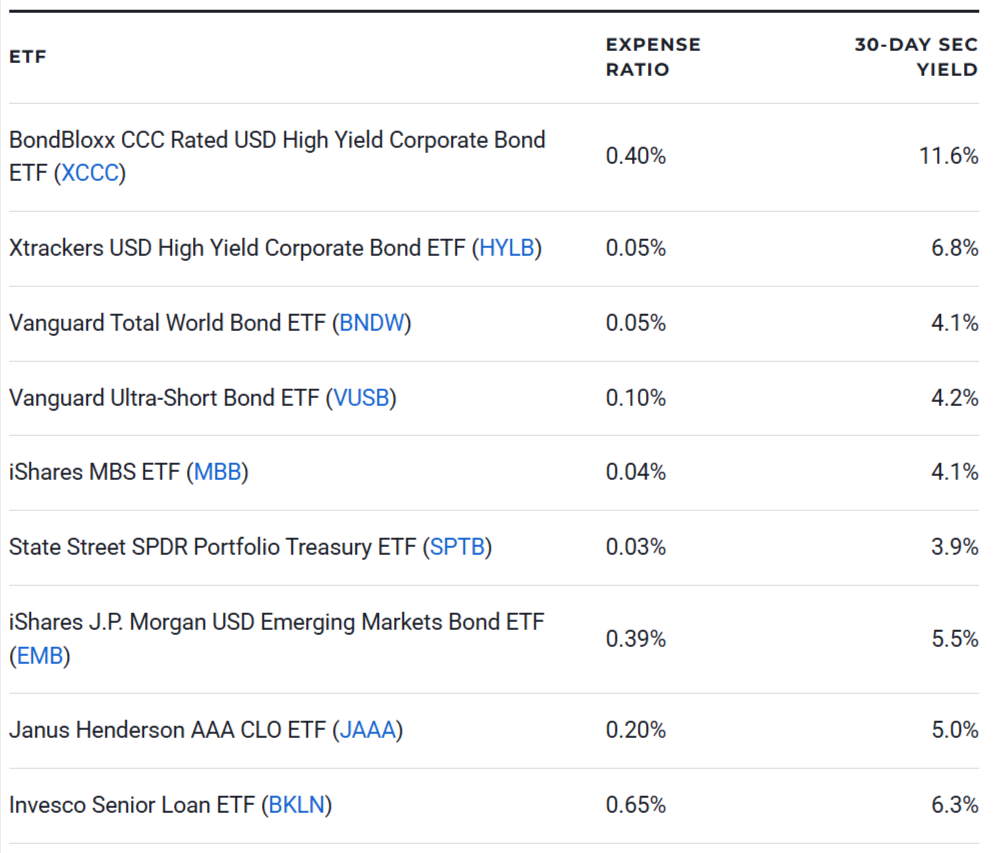
Here are nine of the best bond ETFs to buy for 2026:
ETF
BondBloxx CCC Rated USD High Yield Corporate Bond ETF (XCCC)
Xtrackers USD High Yield Corporate Bond ETF (HYLB)
Vanguard Total World Bond ETF (BNDW)
Vanguard Ultra-Short Bond ETF (VUSB)
iShares MBS ETF (MBB)
State Street SPDR Portfolio Treasury ETF (SPTB)
iShares J.P. Morgan USD Emerging Markets Bond ETF (EMB)
Janus Henderson AAA CLO ETF (JAAA)
Invesco Senior Loan ETF (BKLN)
BondBloxx CCC Rated USD High Yield Corporate Bond ETF (XCCC)
“With yields still elevated, volatility lingering and central banks exercising caution, we believe bonds will continue to drive portfolio returns,” says JoAnne Bianco, partner and senior investment strategist at BondBloxx, an asset manager specializing in fixed-income ETFs. One of its more exotic options is XCCC.
This bond ETF tracks the riskiest segment of high-yield bonds, as represented by the ICE BofA US Cash Pay High Yield Index. CCC-rated bonds pose a relatively high risk of default, but investors owning XCCC get compensated for that with an 11.6% 30-day SEC yield. The ETF charges a 0.4% expense ratio.
Xtrackers USD High Yield Corporate Bond ETF (HYLB)
XCCC is among the riskier bond ETFs available. According to ratings agency S&P Global, CCC-rated bonds have a three-year cumulative default rate of 45.7%. Investors looking to maximize income but with more limits on risk can consider HYLB instead, which targets mostly BB-rated bonds at a 0.05% expense ratio.
“HYLB also has a shorter duration than most peers and offers superior liquidity, as bonds in the portfolio must have a minimum $400 million float,” says Ben Spalding, head of fixed-income portfolio management for Xtrackers Americas at DWS Group. The ETF pays a 6.8% 30-day SEC yield.
Vanguard Total World Bond ETF (BNDW)
“Investors have seen bond ETFs successfully weather multiple storms in the markets, including the pandemic sell-off in March 2020,” says John Croke, head of investor choice business activation at Vanguard. “Time and again, bond ETFs have demonstrated their resilience and liquidity for investors.”
Investors looking for maximum diversification from their bond ETF can consider BNDW. This Vanguard bond ETF holds over 18,000 government and investment-grade corporate bonds from the U.S. and foreign countries. All this comes at a low 0.05% expense ratio. BNDW pays a 4.1% 30-day SEC yield.
Vanguard Ultra-Short Bond ETF (VUSB)
“Rich stock prices and attractive current yields are creating demand for bond ETFs – particularly actively managed ETFs – which helps investors who are seeking portfolio diversification with the additional profit potential that comes from active tilts,” says Stephen McFee, senior portfolio manager at Vanguard.
VUSB does not track an index. Vanguard’s fixed-income managers actively select high-quality, short-maturity bonds with a focus on capital preservation. While not fixed at $1 per share like a money market fund, the net asset value for VUSB is fairly stable. The ETF pays a 4.2% 30-day SEC yield.
iShares MBS ETF (MBB)
“MBS ETFs offer yields that are comparable to investment-grade corporate bonds, accompanied with high credit quality and monthly cash flows,” says Dave P. Francis, investment advisor and principal at Bartlett Wealth Management. These ETFs can provide real estate-linked cash flows with lower risk.
Broad exposure to agency-issued MBS can be achieved by investing in MBB. This ETF owns MBS issued by Ginnie Mae, Fannie Mae and Freddie Mac, which come with government guarantees and a high credit rating. MBB charges a 0.04% expense ratio and pays a 4.1% 30-day SEC yield.
State Street SPDR Portfolio Treasury ETF (SPTB)
“Often overlooked in bond ETFs is liquidity – the ability to buy or sell the security quickly, easily and without a large spread,” says Daniel Dusina, chief investment officer at Blue Chip Partners. “A bond ETF’s liquidity, for the most part, is driven by the liquidity of its underlying securities.”
U.S. government-issued Treasury bonds remain among the most liquid bonds due to the sheer size of their market. Investors can gain broad exposure to the Treasury market via SPTB, which tracks the Bloomberg U.S. Treasury Index. SPTB charges a 0.03% expense ratio and pays a 3.9% 30-day SEC yield.
iShares J.P. Morgan USD Emerging Markets Bond ETF (EMB)
Credit risk generally increases when investors own bonds based in emerging markets. These issuers operate in environments with less predictable monetary policy, greater political risk and, in some cases, weaker legal systems for creditors. To compensate for these risks, investors demand higher yields.
EMB is built around that trade-off. The fund tracks sovereign and quasi-sovereign bonds issued by governments from emerging market countries such as Saudi Arabia, Mexico and Turkey. After accounting for a 0.39% expense ratio, EMB currently offers a 5.5% 30-day SEC yield.
Janus Henderson AAA CLO ETF (JAAA)
CLOs often get mistaken for the collateralized debt obligations responsible for the 2008 financial crisis. Structurally, however, they are different – backed by pools of senior loans rather than subprime mortgages. CLOs also include safeguards such as over-collateralization and interest coverage tests.
JAAA focuses on the safest portion of the CLO capital structure, investing exclusively in AAA-rated CLO tranches. These sit at the top of the payment hierarchy and are designed to absorb losses only after lower-rated tranches are wiped out. JAAA pays a 5% 30-day SEC yield and charges a 0.2% expense ratio.
Invesco Senior Loan ETF (BKLN)
Investors who find CLO structures too complex can target the underlying assets directly through senior loan ETFs. These are first-lien obligations, meaning they rank ahead of other debt in a borrower’s capital structure. They also tend to have floating interest rates, which reduces sensitivity to rising rates.
BKLN is one of the longest-running and most established options in this space, with $6.7 billion in assets. It tracks the Morningstar LSTA U.S. Leveraged Loan 100 Index. In exchange for taking on elevated credit risk, investors receive a 6.3% 30-day SEC yield, though BKLN carries a relatively high 0.65% expense ratio.