The Psychology of Money: Timeless lessons on wealth, greed, and happiness Paperback – September 8, 2020
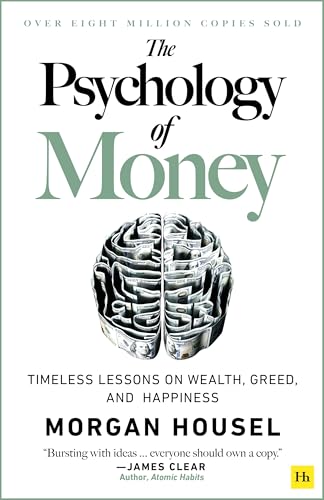
OVER 8 MILLION COPIES SOLD AROUND THE WORLD… The Psychology of Money is the original bestselling classic from the author of the new book, Same as Ever.
Doing well with money isn’t necessarily about what you know. It’s about how you behave. And behavior is hard to teach, even to really smart people.
Money―investing, personal finance, and business decisions―is typically taught as a math-based field, where data and formulas tell us exactly what to do. But in the real world people don’t make financial decisions on a spreadsheet. They make them at the dinner table, or in a meeting room, where personal history, your own unique view of the world, ego, pride, marketing, and odd incentives are scrambled together.
In The Psychology of Money, award-winning author Morgan Housel shares 19 short stories exploring the different ways people think about money and teaches you how to make better sense of one of life’s most important topics.
Editorial Reviews
“It’s one of the best and most original finance books in years.” — Jason Zweig, The Wall Street Journal
“The Psychology of Money is bursting with interesting ideas and practical takeaways. Quite simply, it is essential reading for anyone interested in being better with money. Everyone should own a copy.” — James Clear, Author, million-copy bestseller, Atomic Habits
“Morgan Housel is that rare writer who can translate complex concepts into gripping, easy-to-digest narrative. The Psychology of Money is a fast-paced, engaging read that will leave you with both the knowledge to understand why we make bad financial decisions and the tools to make better ones.” — Annie Duke, Author, Thinking in Bets
“Housel’s observations often hit the daily double: they say things that haven’t been said before, and they make sense.” — Howard Marks, Director and Co-Chairman, Oaktree Capital & Author, The Most Important Thing and Mastering the Market Cycle
“Morgan Housel is one of the brightest new lights among financial writers. He is accessible to everyone wanting to learn more about the psychology of money. I highly recommend this book.” — James P. O’Shaughnessy, Author, What Works on Wall Street
“Few people write about finance with the graceful clarity of Morgan Housel. The Psychology of Money is an essential read for anyone who wants to make wiser decisions or live a richer life.” — Daniel H. Pink, #1 New York Times Bestselling Author of When, To Sell Is Human, and Drive
About the Author
Morgan Housel is a partner at The Collaborative Fund and a former columnist at The Motley Fool and The Wall Street Journal.
He is a two-time winner of the Best in Business Award from the Society of American Business Editors and Writers, winner of the New York Times Sidney Award, and a two-time finalist for the Gerald Loeb Award for Distinguished Business and Financial Journalism. He serves on the board of directors at Markel. /He lives in Seattle with his wife and two kids.
Product details
Publisher : Harriman House
Publication date : September 8, 2020
Language : English
Print length : 256 pages
Item Weight : 2.31 pounds
Dimensions : 5.45 x 0.65 x 8.4 inches
Best Sellers Rank: #18 in Books (See Top 100 in Books)
1 in Budgeting & Money Management (Books)
1 in Introduction to Investing
4 in Success Self-Help
Customer Reviews: 4.7 4.7 out of 5 stars (67,971)
About the author
Morgan Housel
Morgan Housel is a partner at The Collaborative Fund. He is a two-time winner of the Best in Business Award from the Society of American Business Editors and Writers, winner of the New York Times Sidney Award, and a two-time finalist for the Gerald Loeb Award for Distinguished Business and Financial Journalism. He lives in Seattle with his wife and two kids.
Unlocking Financial Wisdom: A Review of “The Psychology of Money”
“The Psychology of Money: Timeless Lessons on Wealth, Greed, and Happiness” is a book that promises to offer valuable insights into the complex relationship between money and human behavior. While I’m only at the beginning of my journey with this book, I’m already impressed by the wisdom it imparts and the quality of its condition.
The first chapter alone is a treasure trove of wisdom, filled with “gems” that challenge conventional thinking about wealth, greed, and happiness. Through captivating storytelling and thought-provoking anecdotes, the author presents timeless lessons that resonate deeply with readers, prompting introspection and sparking new perspectives on financial decision-making.
What sets this book apart is its ability to distill complex concepts into accessible and relatable narratives. Whether discussing the importance of patience in investing or the pitfalls of overconfidence, the author provides practical insights that are applicable to readers from all walks of life, regardless of their level of financial expertise.
Remember: Margin of safety
Why the book was so easy and enjoyable to read? It has a lot of good examples, data, and fun facts to get the point across to the readers. The chapter titles are attention grabbers that get our attention so that we can read more. However, the most important thing to learn from this book is the “Margin of Safety.”
According to the author, it is one of the most underappreciated forces in finance. It comes in many forms: a frugal budget, flexible thinking, and a loose timeline – anything that lets you live happily with a range of outcomes. Controlling your time is the highest dividend money pays.
The book is pretty much evolved around the concept of “Margin of Safety.” It encourages readers to save money and not spend money lavishly. The key is staying wealthy and not just getting wealthy. We can’t be complacent and assume that yesterday’s success translates into tomorrow’s good fortune. Wealth is what you don’t see. Spending money to show people how much money you have is the fastest way to have less money.
Good investing is not about getting the highest returns. It’s about getting good returns that you can stick with and which can be repeated for the longest period of time. According to the author, the historical odds of making money in US markets are 50/50 over one-day periods, 68% in one-year periods, 88% in 10-year periods, and (so far) 100% in 20-year periods.
Forecasting is hard. This is why investment guru Benjamin Graham strongly advocates for the margin of safety, as the purpose of the margin of safety is to render the forecast unnecessary. The author cited the success rate of venture financing from 20024 to 2014: 65% lost money, 2.5% of investments made 10X to 20X, 1% made more than 20X return, and only 1/2% (~100 companies) earned 50X or more.
According to George Soros, it is not important whether you are right or wrong but how much money you make when you’re right and how much you lose when you’re wrong. You can be wrong half the time and still make a fortune.
The most interesting part of the book is the last chapter: Postscript. Thanks to the internet, the world is more connected than ever. That means that the talent pool the readers compete with has gone from 100s or 1000s sprang their towns to millions or billions spanning the globe.
The author ended the book with a not-so-pessimistic note. The era of “this isn’t working” may stick around. And the era of “We need something radically new, right now, whatever it is” may stick around.