Recessions are a normal part of the long-term business cycle of the economy. Recessions can also provide excellent opportunities to buy stocks of high-quality companies at a significant discount to their typical valuations. However, recessions can be scary and intimidating for investors as they watch the majority of stocks drop day after day.
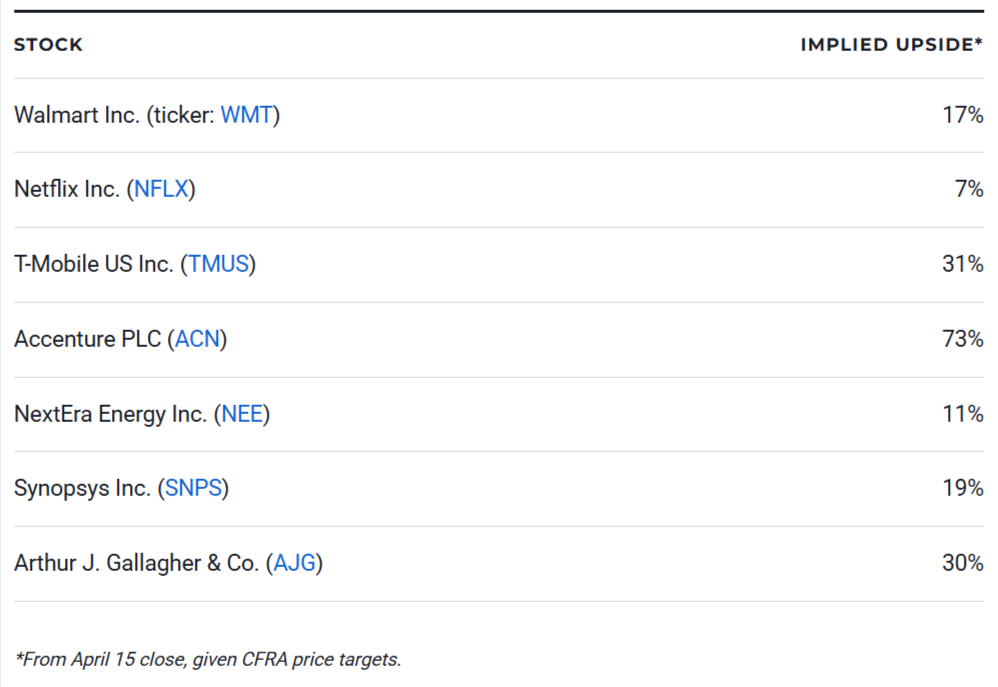
Fortunately, there are a handful of stocks that have historically been recession-proof and have gained ground even in the worst of times. Here are seven stocks CFRA analysts recommend that outperformed the S&P 500 during recessions in the dog days of 2008 and 2020:
Stock
Walmart Inc. (ticker: WMT)
Netflix Inc. (NFLX)
T-Mobile US Inc. (TMUS)
Accenture PLC (ACN)
NextEra Energy Inc. (NEE)
Synopsys Inc. (SNPS)
Arthur J. Gallagher & Co. (AJG)
Walmart Inc. (WMT)
It’s no surprise that discount retailer Walmart outperformed during each of the past two U.S. recessions. Americans can’t go without groceries when times get tough, but they can save money by bargain-hunting at Walmart. Analyst Arun Sundaram says Walmart is successfully transitioning its business model. In fact, Walmart’s high-margin alternative revenue streams now account for about 30% of its total operating income and are growing at an impressive 30% annual rate. As a result, Sundaram says Walmart is expanding its margins while also reinvesting in its business. CFRA has a “buy” rating and a $146 price target for WMT stock, which closed at $124.76 on April 15.
S&P 500 outperformance: 5.1% (2020), 56.3% (2008)
Netflix Inc. (NFLX)
At first glance, it may seem strange that video streaming service Netflix, which relies on discretionary spending, would perform so well during times of economic difficulty. Netflix’s strength in 2008 and 2020 may have to do with Americans cutting back on pricey entertainment options during financial hardship. Netflix provides access to thousands of shows and movies for as low as $8.99 per month. Analyst Kenneth Leon says Netflix has several key growth catalysts, including subscription price hikes, membership growth and an expanding advertising business. CFRA has a “buy” rating and a $115 price target for NFLX stock, which closed at $107.71 on April 15.
S&P 500 outperformance: 50.9% (2020), 50.8% (2008)
T-Mobile US Inc. (TMUS)
After merging with Sprint in 2020, T-Mobile is now the second-largest U.S. wireless provider. Over the long term, T-Mobile has generated consistent growth in a challenging industry, even during economic downturns. Analyst Keith Snyder says network differentiation will help T-Mobile continue to outgrow its competitors in the 5G network era. Snyder says T-Mobile’s 5G network is at least 12 months ahead of other leading networks, and the company’s aggressive pricing strategy has facilitated steady market share gains. He says service revenue growth has been particularly impressive. CFRA has a “strong buy” rating and a $250 price target for TMUS stock, which closed at $190.19 on April 15.
S&P 500 outperformance: 55.7% (2020), 14.8% (2008)
Accenture PLC (ACN)
Accenture is a global information technology services firm. The company generates nearly half its revenue from North America, about a third from Europe and the remainder from other parts of the world. Accenture’s diversified consulting and services business made it recession-resistant in the past and will likely continue to do so in the future. Analyst Brooks Idlet says Accenture has taken an early leadership position in IT artificial intelligence services, which will be critical as customers integrate more AI intelligence into their businesses in coming years. CFRA has a “strong buy” rating and a $335 price target for ACN stock, which closed at $194 on April 15.
S&P 500 outperformance: 7.8% (2020), 29.5% (2008)
NextEra Energy Inc. (NEE)
NextEra Energy is a utility holding company and is the parent of Florida Power & Light, as well as NextEra Energy Resources. Utility sector stocks are generally considered defensive investments and are popular flight-to-safety plays during economic downturns. Utility companies have stable demand, predictable cash flows and limited competition. NextEra shares outperformed the S&P 500 by double-digit percentage points in both 2008 and 2020. Analyst Daniel Rich says NextEra offers investors a unique combination of the growth of an alternative energy investment and the reliability of a regulated utility. CFRA has a “buy” rating and a $101 price target for NEE stock, which closed at $91.24 on April 15.
S&P 500 outperformance: 11.1% (2020), 12.8% (2008)
Synopsys Inc. (SNPS)
Synopsys provides a platform engineers can use to design and test semiconductor chips and other software applications. The global semiconductor industry is a secular growth market, so demand for chip testing and design services is constant – even during an economic downturn. Idlet says silicon-to-systems convergence and rising device complexity have created major AI-driven tailwinds for Synopsys. In addition, he says Synopsys’ $35 billion acquisition of Ansys makes Synopsys a leader in the electronic design automation market, and agentic AI products will further boost electronic design automation growth. CFRA has a “buy” rating and a $521 price target for SNPS stock, which closed at $438.45 on April 15.
S&P 500 outperformance: 70% (2020), 9.9% (2008)
Arthur J. Gallagher & Co. (AJG)
Arthur J. Gallagher is one of the world’s largest international insurance brokers and risk management services providers. Because people and businesses still need insurance even during an economic downturn, the insurance industry is generally considered to be recession-resistant. Analyst Catherine Seifert says Arthur J. Gallagher’s acquisition strategy has helped the company maintain its revenue growth momentum. Seifert says the company will likely continue to outgrow its peers, and that growth will provide a catalyst for the stock and help it maintain its premium valuation. CFRA has a “buy” rating and a $290 price target for AJG stock, which closed at $223.17 on April 15.
S&P 500 outperformance: 13.7% (2020), 45.5% (2008)