5 Best Nuclear Energy Stocks and ETFs to Buy
If you’re looking for a picks-and-shovels way to play the artificial intelligence boom, you could do worse than invest in the supply chain that provides it with electricity.
Because of the computing power needed for AI calculations and the cooling that is needed for those computers, the data centers that house AI servers consume a lot of electricity. An April report from the International Energy Agency projected that electricity consumption from data centers will grow to 945 terawatt-hours by 2030 from 415 TWh in 2024, a rise of about 15% per year. According to a July report from consulting firm Ducker Carlisle, U.S. data center electricity demand is expected to rise by roughly 400 TWh, or 23%, between 2024 and 2030.
Much of that supply is expected to come from nuclear energy. Unlike natural gas and coal, nuclear power doesn’t produce greenhouse gas emissions even while being able to generate stable baseload power for homes and businesses when intermittent solar and wind power can’t.
The green aspect of nuclear energy is particularly attractive to Big Tech companies that want to burnish their sustainability credentials. Microsoft Corp. (ticker: MSFT), Alphabet Inc.’s (GOOG, GOOGL) Google, Meta Platforms Inc. (META) and Amazon.com Inc. (AMZN) have all indicated they want nuclear-powered data centers.
“Power-hungry AI data centers crave reliable baseload power around the clock,” says Benjamin Rains, stock strategist and editor of Alternative Energy Innovators at Zacks Investment Research. “This is why Microsoft, Amazon, Meta and Alphabet are all signing deals with nuclear energy companies to power their energy-intensive AI growth.”
The U.S. government is also getting behind the nuclear theme. Executive orders from President Donald Trump have added to Joe Biden-era support in the Infrastructure Investment and Jobs Act and the Inflation Reduction Act, on top of other congressional action.
“The U.S. government, under Biden and now Trump, has ramped up its efforts to support nuclear energy growth, aiming to help cut red tape and actively support the industry through tax credits, grants, loans and more,” Rains says.
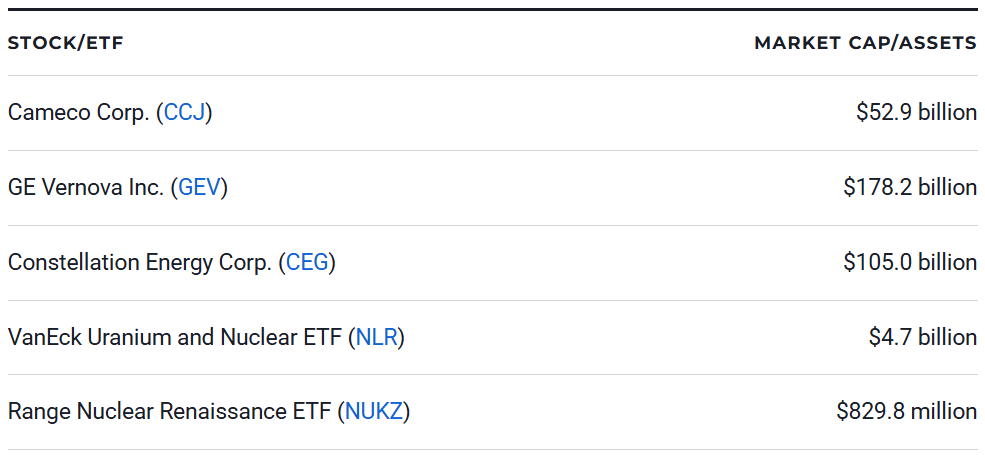
With that in mind, here are five ways to invest in the nuclear renaissance:
Stock/ETF
Cameco Corp. (CCJ)
GE Vernova Inc. (GEV)
Constellation Energy Corp. (CEG)
VanEck Uranium and Nuclear ETF (NLR)
Range Nuclear Renaissance ETF (NUKZ)
Cameco Corp. (CCJ)
During a slump after the 2011 Fukushima Daiichi nuclear reactor disaster in Japan, the uranium mining industry cut back on investment and is now playing catch-up.
While many small mining companies have been ramping up uranium production and exploration, they can be quite risky, although their upside can be substantial. In contrast, Cameco is the world’s second-biggest uranium miner, which means the company is less risky than exploration companies that aren’t yet in production.
“As a portfolio manager, I am most excited about Cameco in the nuclear energy space,” says Tyler Kocon of Split Rock Private TradingThe stock is the third-biggest holding in the company’s North Shore Equity Rotation ETF (KOOL), right behind AI processing powerhouse Nvidia Corp. (NVDA)。
“After nearly two decades of flat electricity demand, U.S. power usage is beginning to rise meaningfully,” he says. “To meet this demand, we see nuclear power as an essential part of the solution, and Cameco is ideally positioned.”
Canada-based Cameco is set to benefit from restrictions on Russian uranium imports, Kocon says. The company also has a 49% stake in nuclear equipment and services company Westinghouse, giving it exposure in the full nuclear supply chain, from uranium mining to fuel refining and nuclear plant construction, Kocon points out.
Last year, the U.S. government entered a partnership with Westinghouse that “provides financing assistance and streamlined permitting, two of the biggest barriers to new reactor development,” he says.
GE Vernova Inc. (GEV)
This company is a play on small modular reactors, or SMRs. These reactors represent the next generation of nuclear power generation alongside micro reactors, advanced enrichment methods and new fuel types.
GE Vernova and Hitachi are working on an SMR design, with construction of the first unit expected to be complete by 2029 and commercial operation by the end of the following year.
“SMR companies such as GEV envision a not-so-distant future where they build their small-scale nuclear reactors directly on site at AI data centers, industrial buildings, military bases and really anywhere, even the moon,” Rains says.
But GEV also has legacy business in addition to cutting-edge SMRs.
“GEV has provided nuclear turbine technologies and services for all reactor types for decades, which helps it benefit from upgrades happening across the current fleet and the planned build-out of more large-scale reactors in the U.S. and beyond,” says Rains.
However, there are cautions to keep in mind.
“CCJ and GEV are volatile, and you have to pick your entry points carefully,” Kocon says. “Additionally, the reactor industry is ripe with cost overruns and lengthy construction timelines.”
Constellation Energy Corp. (CEG)
There are two main ways investors can play the nuclear theme through utilities. One is by owning utilities with nuclear plants that can charge premiums to tech companies. The other is with nuclear utilities that could benefit if regulators decide they want to prioritize nuclear development.
Constellation falls into the first bucket. With the biggest fleet of nuclear plants in the U.S., Constellation is an obvious choice as a source for Big Tech to turn to for its nuclear energy needs. Meta has a 20-year nuclear agreement with Constellation. And Microsoft has agreed to purchase energy from a Constellation-revived unit at the Three Mile Island nuclear power plant in Pennsylvania.
“These deals are helping CEG keep some of its plants running longer and helping it pursue its next-generation small modular reactors ambitions,” Rains says. “Nuclear-focused tax credits are also helping boost its earnings. Plus, it pays a dividend.”
Constellation added to its status as an AI titan with its recent acquisition of natural gas and geothermal energy utility Calpine, Rains points out.
VanEck Uranium and Nuclear ETF (NLR)
Investors who want to spread out the risk with a more diversified investment than single stocks can consider exchange-traded funds, or ETFs, which trade under a single ticker symbol but contain a basket of equities.
This ETF invests in uranium mining companies; companies that build, engineer and maintain nuclear power facilities and reactors; companies involved in the production of electricity from nuclear sources; and companies that provide equipment, technology or services to the nuclear power industry.
The fund tracks the performance of the MVIS Global Uranium & Nuclear Energy Index, which is up more than 60% over the past 52 weeks. The ETF has an expense ratio of 0.56%, or $56 per year for every $10,000 invested.
Range Nuclear Renaissance ETF (NUKZ)
ETFs can also be a good idea for investors who want exposure to development-stage companies that have a high potential for reward but are also very risky, such as AI executive Sam Altman-backed advanced nuclear fission startup Oklo Inc. (OKLO)。
Like the VanEck ETF, this fund has Oklo as one of its holdings and is diversified along the nuclear supply chain, giving investors exposure to companies involved in advanced reactors, utilities, construction, services and fuel.
Both of these funds include utility companies, which can give them a defensive tinge. Utilities are unlikely to outperform growth stocks during times of economic expansion and stock market optimism. But when economic performance falters, utilities can act as a portfolio cushion because houses and businesses need electricity year-round, regardless of economic conditions.
That stability comes with the downside that these ETFs won’t likely perform as well as a single stock that hits it big.
NUKZ has an expense ratio of 0.85%. The fund is up about 40% over the past 52 weeks.