Robotics companies have converted the pages of science fiction books into real life, as artificial intelligence-powered humanoid machines are in the early stages of development. The industry is growing quickly and has a high ceiling, which can translate into significant long-term gains for patient investors.
While humanoid robots are still in their infancy, with companies like Tesla Inc. (ticker: TSLA) and BYD Co. Ltd. (OTC: BYDDY) leading the charge, warehouses are already using robots to streamline the movement of millions of product orders per day. Autonomous driving is also gaining momentum thanks to Waymo’s robotaxis and Tesla’s “Cybercabs,” highlighting the vast scaling potential robots have.
Advances in artificial intelligence technology have made it easier to create effective robots. At any given moment, robots are the least sophisticated they will ever be. The technology will continue to get better and revolutionize many industries.
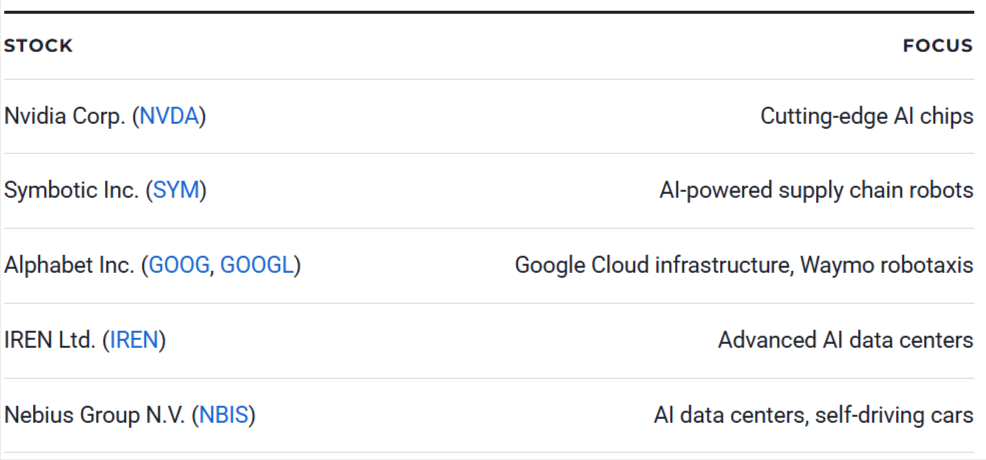
Here are some of the robotics stocks that are leading the charge and can generate long-term returns for investors:
StockFocus
Nvidia Corp. (NVDA)
Symbotic Inc. (SYM)
Alphabet Inc. (GOOG, GOOGL)
IREN Ltd. (IREN)
Nebius Group N.V. (NBIS)
Nvidia Corp. (NVDA)
Nvidia produces the leading AI chips that robots need to function at their best. Many of the Big Tech companies that are scrambling to build robots are also loading up on AI chips. While competitors like Broadcom Inc. (AVGO) and Advanced Micro Devices Inc. (AMD) are also viable options, Nvidia is the clear leader in the industry.
Nvidia also has its own automotive/robotics segment that brought in $586 million in revenue in the second quarter of its fiscal 2026. It’s a small slice of Nvidia’s total revenue, but key partnerships and a rapidly growing industry suggest that this segment can become a meaningful contributor to Nvidia’s future growth.
Nvidia’s “Mega” Omniverse Blueprint already enables the digital infrastructure for robot fleets. Developers can use this platform to build, train and deploy robots. While robotics remains a compelling opportunity for Nvidia, the stock lost momentum but still added 30% over the past year based on the strength of its overall business.
Symbotic Inc. (SYM)
If you think the future of warehouses consists of many robots moving products to various locations with the involvement of fewer human employees, you may want to take a closer look at Symbotic. The company creates AI-powered robots that streamline the supply chain and allow companies to deliver higher order volumes.
Symbotic has a multi-year partnership with Walmart Inc. (WMT) that is still going strong. In January 2025, Walmart chose Symbotic to develop, build and deploy an advanced solution that automates its Accelerated Pickup and Delivery centers. The initial partnership covers hundreds of stores, but Symbotic stands to boost its revenue considerably if Walmart expands the partnership. Symbotic also works with Target Corp. (TGT), Albertsons Cos. Inc. (ACI) and other retail giants. If customers recognize the efficiencies Symbotic robots add to their business, it may be hard for them to go back.
Revenues jumped by 26% year over year in the third quarter, and more investors have been recognizing SYM’s potential. Its share price is up 167.6% over the past year as of Jan. 5, crushing the S&P 500’s 16% return over that stretch.
Alphabet Inc. (GOOG, GOOGL)
Alphabet has evolved into far more than just a search engine. Google Cloud’s computing power allows robots to come to life and perform at their best. Samsung Electronics Co. Ltd. (005930.KS), Brain Corp. and Guardforce AI Co. Ltd. (GFAI) are some of the companies that use Google Cloud’s infrastructure to build and manage their robots.
Google Cloud has become a major growth engine for Alphabet, as its revenue expanded by 34% year over year in the third quarter. The recent addition of Google Gemini could drive further revenue acceleration in the future. Gemini optimizes Google Cloud’s offerings while acting as a ChatGPT competitor for search users. Gemini is a bid to keep Google search relevant in a world of AI chatbots. Overall revenue increased by 16% year over year, indicating that fears of a search engine apocalypse are overblown.
Alphabet also owns Waymo, a small part of the business that could produce tremendous returns in the long run. Waymo recently rolled out autonomous vehicles in Phoenix, San Francisco, Los Angeles, Atlanta and Austin, Texas. It’s also looking to expand into other markets. Waymo’s potential may not be fully priced into Alphabet’s stock quite yet, some analysts say.
IREN Ltd. (IREN)
Robots can perform many tasks autonomously, but to work efficiently, they have to consume a lot of energy. For instance, a single ChatGPT search uses roughly 10 times as much energy as a regular Google search. (That’s not to mention Gemini, Grok and other language models.) Humanoid robots and other innovations will also require energy, and that’s where IREN comes into the picture.
IREN is a Bitcoin miner that has recently pivoted to AI infrastructure. The company produces AI data centers at scale, which are more advanced than traditional data centers. Even though the stock remains somewhat under the radar with a market cap around $15 billion, it has been spotlighted in X (formerly Twitter) communities and has a one-year gain that is approaching 290%.
It operates on 100% renewable energy and has secured 2.9 gigawatts of energy. Big Tech companies have been scrambling to make deals with crypto miners that have pivoted into AI data center firms, and IREN landed a Microsoft Corp. (MSFT) contract worth $9.7 billion in late 2025 to deploy AI cloud infrastructure. Soaring AI investments and energy consumption may help companies like IREN trade at a premium.
Nebius Group N.V. (NBIS)
Nebius is another company that has pivoted into AI data centers, with its own big deal with Microsoft in place and a separate autonomous vehicle stake. The deal with Microsoft involves tapping into 300 megawatts of energy that will fuel the tech giant’s AI ambitions. The five-year contract nets $17.4 billion for Nebius, with the possibility to increase to a $19.4 billion contract in exchange for more megawatts.
Nebius aims to have 2.5 gigawatts of power by the end of 2026, which means it could make plenty more deals like the Microsoft arrangement. Thanks to strong demand, that power level is more than double its previous guidance. The company also does full-stack infrastructure, which means it provides hardware and software, such as cloud platforms and developer tools.
Nebius also has exposure to autonomous vehicles through its large stake in Avride, a company that develops technology for self-driving cars and delivery robots. NBIS shares have climbed by more than 200% over the past year.