Semiconductor stocks are having a banner year, with the benchmark PHLX Semiconductor Index (SOX) churning out a 34.5% return year to date as of Dec. 17, more than doubling the broader S&P 500, which has a 14.3% return over the same time frame.
Chip companies can largely thank hyperscalers for pouring money into artificial intelligence data centers (especially graphics processing unit, or GPU, and application-specific integrated circuit, or ASIC, networking), lifting the whole chip stack via a massive spending spree. Demand for chips, mainly from AI servers that require equally massive high-end memory and advanced packaging, has boosted the fortunes of the leading semiconductor stocks.
“We’re in the middle of a pretty major reassessment of the semiconductor trade,” says Michael Martin, vice president of market strategy at Chicago-based Trading Block.
Other market watchers are bullish on semiconductors over the next few quarters. “The main driver is AI-related demand, data centers, cloud capex, advanced computing, and that’s not slowing down yet,” says Jack Fu, CEO at Draco Evolution, a digital-based AI and quantitative investment research services firm.
The current semiconductor run feels more structural than past ones. That said, it won’t be a straight line, Fu notes. “We’ll see volatility around inventory, macro data and geopolitics, but the overall trend for chips remains up as AI spending continues to expand,” he says.
Cash-wise, the semiconductor spigot is wide open, with a recent Deloitte report noting that $700 billion will be spent on chips in 2025 alone.
“Memory prices are also rebounding, and capital investment is flowing into semiconductor fabrication facilities,” says Tobias Robinson, a veteran investment analyst and CEO of DayTrading.com. “Yes, tariffs, politics and oversupply all remain risks, but overall we’re still seeing demand push the sector higher. With this growth acceleration, it looks to be a period of what we call ‘mid-cycle expansion,’ with strong momentum on its side.”
Basically, there’s a lot of hype on chip stocks, but Robinson said it’s justified. “The chip trade isn’t new, but we forget how many investors are still piling in,” he adds.
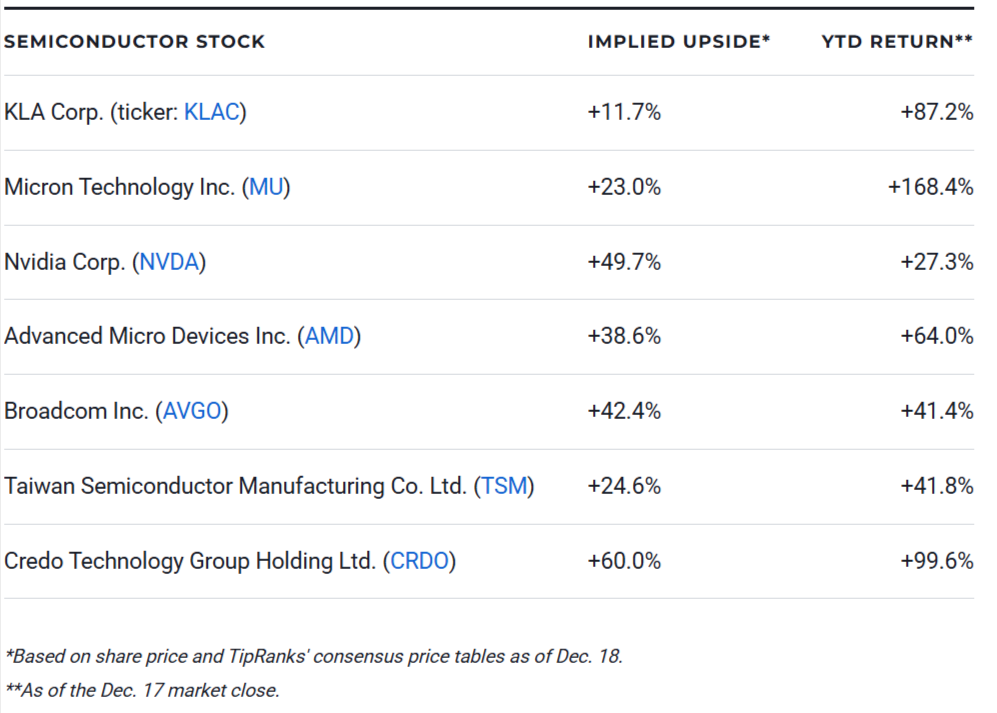
So, which chip companies rule the roost heading into 2026? These semiconductor firms top that list, as evidenced by their year-to-date performance and how much room they have to run, according to Wall Street analysts:
SEMICONDUCTOR STOCK
KLA Corp. (ticker: KLAC)
Micron Technology Inc. (MU)
Nvidia Corp. (NVDA)
Advanced Micro Devices Inc. (AMD)
Broadcom Inc. (AVGO)
Taiwan Semiconductor Manufacturing Co. Ltd. (TSM)
Credo Technology Group Holding Ltd. (CRDO)
KLA Corp. (KLAC)
Year-to-date performance: +87.2%
Potential upside: +11.7%
Trading above $1,220 per share, this Milpitas, California-based semiconductor process control and yield management company is up 87% for the year to date. The company is increasingly leveraging chipmakers who are snapping up advanced components for producing AI chips, which is right in KLA’s wheelhouse.
Blayne Curtis, a Jefferies analyst, states in a new research note that KLA is in a semiconductor sweet spot amid rising demand from companies seeking more AI chip manufacturing solutions. Curtis, who recently moved KLAC from “hold” to “buy,” sees KLA shares rising to $1,500 in 2026.
Micron Technology Inc. (MU)
YTD performance: +168.4%
Potential upside: +23%
Boise, Idaho-based Micron excels in the innovative memory and storage solution realm, and it’s done a bang-up job in 2025. The stock is up 168% year to date and 41% over the past three months.
MU should be in store for more gains, buoyed by robust demand in the high-bandwidth memory sector, a steady history of healthy revenues and earnings, and strong spending in AI data. Wedbush analyst Matt Bryson recently maintained his “outperform” rating on MU shares and set a $300 price target (well above his most recent $220 target)。 Kevin Cassidy, a Rosenblatt technology analyst, also issued a $300 price target for MU with an updated “buy” rating.
Other market professionals share that sentiment, placing Micron in the top tier thanks to strong demand. “I like the names on the power and memory side because AI data centers are becoming extraordinarily power-intensive and memory-hungry, so you obviously need to think of Micron,” says Shay Boloor, chief marketing strategist at Futurum Equities.
Nvidia Corp. (NVDA)
YTD performance: +27.3%
Potential upside: +49.7%
Nvidia, along with Taiwan Semiconductor, still sits at the center of the AI supply chain, Fu says. “Nvidia tops out with design and acceleration, while TSMC rules on manufacturing. That hasn’t changed.”
NVDA hasn’t been delivering knockout numbers, but the stock is up 27% for the year, and the company should benefit from rising demand for H200 chips in China. Nvidia also posted 62% revenue growth in the third quarter, with data center revenue up 66% year over year. The company’s acquisition of SchedMD, a Utah-based software company that manages AI workloads and high-performance computing operations, adds yet another link in Nvidia’s AI-powered partnership chain, joining previous pickups. The consensus analyst outlook on Nvidia is a robust “buy” call, with 50% potential upside to the share price.
“Nvidia is still the anchor because nothing else matches its full-stack advantage in training and inference, and the backlog of Blackwell and Rubin demand extends well beyond 2025,” Boloor notes.
Advanced Micro Devices Inc. (AMD)
YTD performance: +64%
Potential upside: +38.6%
Santa Clara, California-based Advanced Micro Devices is in full turnaround mode, with its share price up 64% year to date and up 24.5% over the past 90 days. AMD is another emerging giant in the AI data center sector, with developers looking to harness the company’s GPUs and server processors to accelerate and improve the reliability of technology development.
AMD counts OpenAI and Microsoft Corp. (MSFT) as industry partners, and it has worked with Taiwan Semiconductor on 7-nanometer processing technology and is developing 3nm and 2nm chips via the Instinct MI350/MI450 series. Company management expects its data center operations to deliver a 60%-plus annual growth rate through 2030, which exceeds the 52% compound average rate for data center revenue AMD has generated over the past five years.
AMD, like other data center powerhouses such as Nvidia, will have to overcome rising challenges, such as limited electricity available for its data center development. Still, help should be on the way from the U.S. government to expand utility channels in the next several years. Consensus analyst views on AMD center on AI demand growth, and their average price target for the next 12 months represents a 39% share-price upside.
Broadcom Inc. (AVGO)
YTD performance: +41.4%
Potential upside: +42.4%
Now trading around $327 per share, Broadcom is another respectable chip play, with AVGO returning 41% year to date, though the share price has shaved off about 6% over the past three months. That’s after a 21% weekly slide in mid-December, one of its worst performances in half a decade.
The company has a significant alliance with Anthropic that could generate additional revenues from two recent chip orders, one for $10 billion and a later order for $11 billion. In October, Broadcom also announced a strategic collaboration to deploy 10 gigawatts of OpenAI-designed AI accelerators.
Jefferies analysts are big backers of the stock, with a “buy” rating and a $500 price target. “Sticking with AI into 2026 as ASICs inflect and hyperscaler capex accelerates,” Jefferies’ Blayne Curtis wrote about Broadcom. “AI should lift (semiconductor capital equipment), driving demand.”
Taiwan Semiconductor Manufacturing Co. Ltd. (TSM)
YTD performance: +41.8%
Potential upside: +24.6%
Taiwan Semiconductor shares are up 42% so far in 2025, primarily driven by the chip provider’s strong alliances with tech sector elites like Nvidia, Advanced Micro Devices, Apple Inc. (AAPL) and Broadcom. The company’s recently released third-quarter numbers show outperformance, with a 51% earnings spike, driven by a 42% sales jump. The company is also exceedingly bullish on its upcoming 2nm chip manufacturing technology and said it’s seeing strong preorder demand for its next-generation chips.
“TSMC remains the quiet center of gravity for the entire industry because advanced packaging and leading-edge capacity are still irreplaceable, and the foundry tightness in 3nm and 2nm nodes supports pricing strength through 2026,” Boloor says.
Expect TSMC, the world’s largest semiconductor chip manufacturer, to benefit from booming demand, particularly from the AI sector, where demand is sky-high. Leading government figures concur, and U.S. Commerce Secretary Howard Lutnick told CNBC in December that he expects TSMC to boost its U.S. tech investments from $165 billion to $200 billion and create 30,000 jobs in the process, though there wasn’t any immediate evidence of that increase.
Credo Technology Group Holding Ltd. (CRDO)
YTD performance: +99.6%
Potential upside: +60%
This 17-year-old Cayman Islands-based data infrastructure company has soared in 2025, and its stock price is up 100% for the year; however, it’s given back significant gains in the past three months. Credo provides high-performance, cost-effective semiconductor solutions for chip-intensive markets, including telecommunications, networking and data infrastructure.
Analysts remain bullish on CRDO shares, with a consensus target price that represents 60% upside. The company’s stock is up 1,700% since its initial IPO in early 2022. Credo is a classic technology “picks and shovels play,” via its active electrical cables that connect servers and switches in AI data centers, and with its serializer and deserializer chiplets, which help companies with high-bandwidth connections.
Credo’s latest 10-Q filing showed continued growth, with product sales revenue rising by 278% year over year for the six months ended Nov. 1. The company should continue to excel in the high-speed-connectivity market, as the sector’s plumbing specialist, a boring but highly profitable role that’s served shareholders well in the past three years or so.
How to Invest in Semiconductor Stocks and Funds Now
Investors, particularly new ones to the sector, should avoid chasing short-term hype and instead focus on diversified exposure. “Use ETFs as a base, then layer in high-quality leaders if valuations make sense,” Fu advises. “Expect pullbacks, which are normal in this sector, but the long-term thesis around AI, compute demand and advanced chips is still intact.”
“Position size and risk control matter more than trying to time every move,” Fu adds.
Investors should also expect semiconductor stocks to rise and fall together, especially during periods of elevated volatility. “Because of that, I’m less focused on picking individual names right now,” Martin notes. “However, if we see another significant dip, I would likely increase my exposure in the VanEck Semiconductor ETF (SMH)。”